
TL;DR: Across U.S. Google Business Profiles, calls and website clicks fell roughly 12% year over year in Q2 2026, while direction requests rose about 21%. Customers are finishing the whole decision inside Google Maps instead of clicking through to your site. If you still judge local SEO by phone volume alone, you’re reading the wrong gauge, and the fix is to treat your profile as the storefront it has quietly become.

Success metrics for Google Business Profiles need a refresh. This episode shows why direction requests and profile views should now sit alongside phone calls, and how focusing on completeness and categorization can dramatically improve rankings.
What changed: Google Maps is now where the decision happens
Local customers are increasingly choosing a business without ever leaving Google Maps.
That’s the short version of an analysis GMBapi published in late August 2026, which looked at 179 Google Business Profiles alongside SOCi’s 2026 Local Visibility Index. The pattern held across two straight quarters.
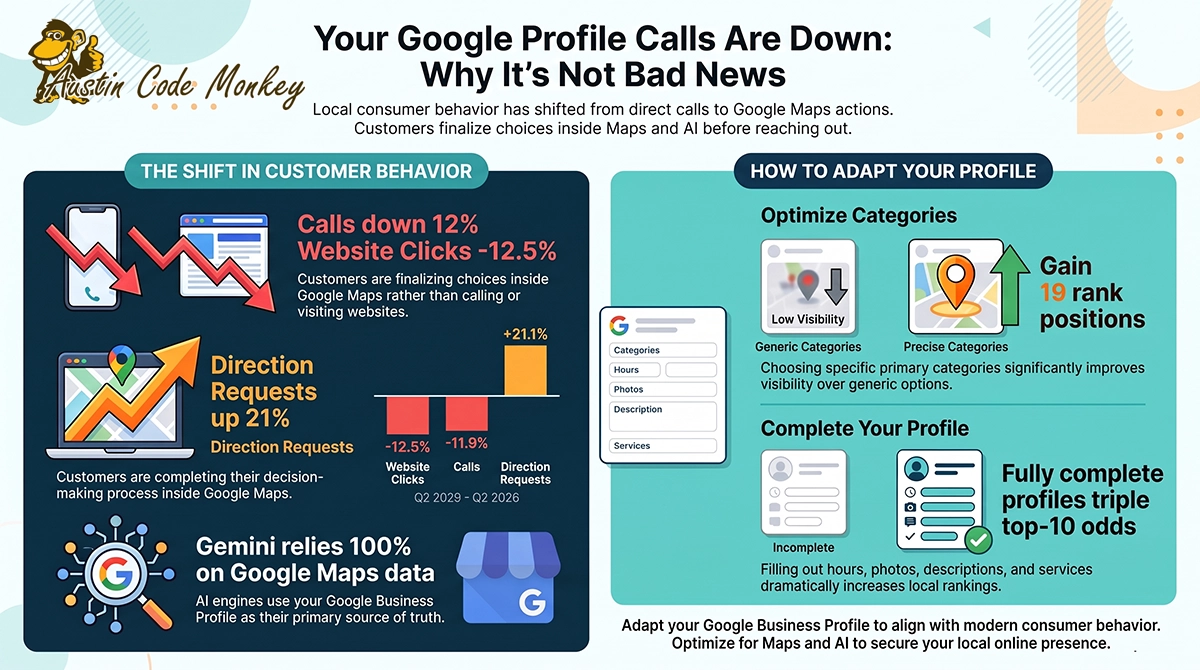
Here’s what the Q2 2026 numbers looked like compared to Q2 2025:
| Metric | Year-over-year change |
|---|---|
| Website clicks | down 12.5% |
| Calls | down 11.9% |
| Direction requests | up 21.1% |
| Mobile Maps impressions | up 30.4% |
Q1 was even sharper. Calls and website clicks were each down 15.8%, and direction requests were up 31.3%.
Put those together, and the story writes itself. People are seeing your business more on mobile Maps, reading what’s there, and then just driving over. Or picking a competitor. Either way, they’re not clicking through to your homepage to decide.
Why your phone is quieter even if your visibility is fine
A drop in calls is not automatically a drop in demand.
I have this conversation with business owners a lot. They open their GBP Performance tab, see calls down, and assume something broke. Sometimes something did break. More often the customer journey just moved, and the dashboard they’re watching wasn’t built for where it went.
Think about how you pick a taco spot or a tire shop now. You open Maps, look at the photos, skim reviews, check the hours, and tap directions. You don’t call to ask if they’re open. Google already told you.
For storefront businesses, that means direction requests are now a lead metric deserving the same weight as calls. For service-area businesses like plumbers and roofers who don’t get direction requests the same way, it means your profile has to answer the questions people used to call about, or they’ll call somebody whose profile does.
The second ranking system nobody’s talking about enough
There are now effectively two ways a local business gets surfaced: the traditional Maps pack, and AI answers that summarize local options.
The GMBapi analysis flagged something I think is the real headline. When they checked how accurately AI tools described business profiles, ChatGPT and Perplexity averaged around 68% accuracy. Gemini hit 100% because it pulls directly from Google Maps data.
My read on that: your Google Business Profile isn’t just a Maps listing anymore. It’s the source of truth Google’s own AI uses to describe you. If your hours are stale, your categories are vague, or your services list is half-filled, that’s what gets repeated back to a customer asking Gemini who to hire. And the other AI tools are guessing even more.
That’s a pretty strong argument for getting the profile right before you spend another dollar on your website.
What actually moves the needle: completeness and specificity
Whitespark’s study of 1.8 million profiles found that complete, specifically categorized profiles rank meaningfully higher.
Darren Shaw’s team published this in August 2026, covering 4,209 business categories. Two findings stood out:
- Specific primary categories beat generic ones. Businesses using a precise category (“Electrician” instead of “Contractor”) averaged about 19 rank positions better and showed up in the top 10 more often.
- Completeness roughly triples top-10 odds. On a 0 to 5 completeness scale covering website, description, hours, photos, and claimed status, fully complete profiles averaged rank 43 versus rank 62 for empty ones, with top-10 appearances jumping from 4% to 13%.
None of this is glamorous. That’s sort of the point. The businesses winning in Maps right now are mostly the ones that did the boring stuff thoroughly.
A practical checklist for the Maps-first customer
Here’s where I’d start if this were my profile:
- Re-check your primary category. Pick the most specific one that’s accurate. Add secondary categories that match services you actually sell.
- Fill every field. Description, hours (including holiday hours), services, attributes, service areas. Every blank is a question a customer has to call to answer, and increasingly they won’t.
- Add real photos regularly. Your actual trucks, crew, storefront, and finished jobs. Stock photos don’t help anyone decide.
- Answer common questions on your site with FAQ schema. Google removed native Q&A from Business Profiles in late 2025, so the questions people used to ask there need a home on your website, marked up so search and AI can read them.
- Change what you measure. Report direction requests next to calls. If you’re service-area, watch profile views and website clicks together, and track booked jobs from Maps with a dedicated tracking number or UTM link.
- Keep posting. Fresh Google Posts and a steady trickle of reviews signal an active business to both the pack and the AI layer.
What this means for your business
If your local leads feel softer this year, audit the profile and your reporting before you assume your SEO stopped working.
This is the core of our local SEO and Google Business Profile work at Austin Code Monkey. We recently rebuilt our own local architecture around this shift: a 20-market service-area optimization, a 20-week Google Posts calendar, FAQ schema replacing the old Q&A feature, and a Northwest Austin hub page with five neighborhood spoke pages. We tested it on ourselves first, which is usually how we like it.
If you’d like a second set of eyes on your profile and what your numbers are really telling you, our local SEO and Google Business Profile optimization team is happy to walk through it with you. No guarantees on rankings, because nobody honest can promise those. Just a clear read on what’s broken and what isn’t.
Frequently Asked Questions
Why are my Google Business Profile calls going down in 2026? Calls from Google Business Profiles fell about 12 to 16% year over year in the first half of 2026 because more customers now decide inside Google Maps using photos, reviews, and hours instead of calling. Direction requests rose 21 to 31% over the same period.
Are direction requests a good metric for local SEO? Yes. For storefront businesses, direction requests now deserve the same weight as calls, since they represent customers who chose you without needing to phone first.
Does Gemini use my Google Business Profile? Yes. Gemini pulls local business information directly from Google Maps data, which is why one 2026 analysis found it described business profiles accurately 100% of the time, compared with about 68% for ChatGPT and Perplexity.
What’s the fastest way to improve my Google Maps ranking? Choose the most specific accurate primary category and complete every profile field. Whitespark’s study of 1.8 million profiles found complete profiles were roughly three times as likely to appear in the top 10.
Can I still use Q&A on my Google Business Profile? No. Google removed native Q&A from Business Profiles in late 2025, so common customer questions should be answered on your website with FAQPage schema.
Still have questions?
The rules of local search are being rewritten in real time, and most businesses don’t find out until a competitor shows up in Gemini’s answer instead of them. Austin Code Monkey specializes in feeding the AI what it needs: business data that’s structured, verified, and descriptive enough for Gemini, ChatGPT, and Google’s AI Overviews to choose you over the competition.
Contact us today to run an AI Visibility Audit and see exactly how your business appears (or doesn’t) across ChatGPT and the other AI search tools your customers are already using.
Austin Code Monkey
Phone: (737) 932-7532
Hours: Monday – Friday, 10:00 AM – 10:00 PM
Website: https://austincodemonkey.com/
Get Started Today:
- Schedule your complimentary SEO audit
- Discover how SEO and AI Search Optimization can transform your business
Don’t let your competitors dominate your business in search queries. Partner with Austin’s leading SEO company and ensure your business appears when and where your customers are searching. Contact Austin Code Monkey today and take the first step toward complete digital dominance in the Austin market.