
Finding the right keywords for your Austin service business means identifying the specific search terms local customers use when they need your services—then optimizing your website and Google Business Profile to appear when those searches happen. Most service businesses target obvious phrases like “Austin plumber” while missing dozens of high-converting variations that face less competition and attract customers ready to hire.

This guide walks you through the exact keyword research process that works for Austin service providers, from discovering neighborhood-specific search terms to tracking which keywords actually generate phone calls and revenue.
Unlock the exact keyword strategy Austin Code Monkey uses to dominate local searches for service businesses. This episode breaks down high-intent terms with emergency modifiers (“emergency plumber near me”), neighborhood-specific phrases, and voice-search conversational queries—plus how to validate volume and outrank competitors. Start winning more jobs at https://austincodemonkey.com!
Austin-Focused Keyword Types That Drive Service Leads
Choosing the right keywords for your Austin service business starts with understanding four distinct keyword categories. Each type captures customers at different stages of their search journey, from initial research to ready-to-hire urgency.
Service + Austin Core Phrases
These foundational keywords combine your primary service with “Austin” or “Austin TX.” Think “plumber Austin,” “Austin HVAC repair,” or “pest control Austin TX.” While these phrases face more competition than longer variations, they capture searchers with clear buying intent who already know what service they want.
Emergency and 24-Hour Modifiers
Urgent service keywords like “emergency plumber Austin” or “24 hour locksmith Austin” attract customers who need immediate help. These searches convert at higher rates than general service queries, even with lower monthly search volumes. When someone searches for emergency service at 2 AM, they’re calling the first business they find.
Cost and Near Me Long Tails
Price-focused searches reveal customers comparing options before they commit. These longer phrases face less competition while still attracting qualified leads:
- “how much does house cleaning cost in Austin”
- “electrician near me Austin Texas”
- “affordable landscaping services Austin”
- “Austin HVAC repair cost estimate”
The “near me” variations capture mobile searchers looking for service in their current location.
Competitor Comparison Keywords
Searches like “best Austin landscaper” or “top rated plumber South Austin” show customers actively evaluating their options. You can also target specific competitor names combined with “alternative” or “vs” if you’re confident in your competitive advantages, though this works best when you genuinely offer something different.
Step-By-Step Keyword Research Workflow for Austin Providers
Effective keyword research follows a systematic process that keeps your efforts focused on terms that actually drive business results.
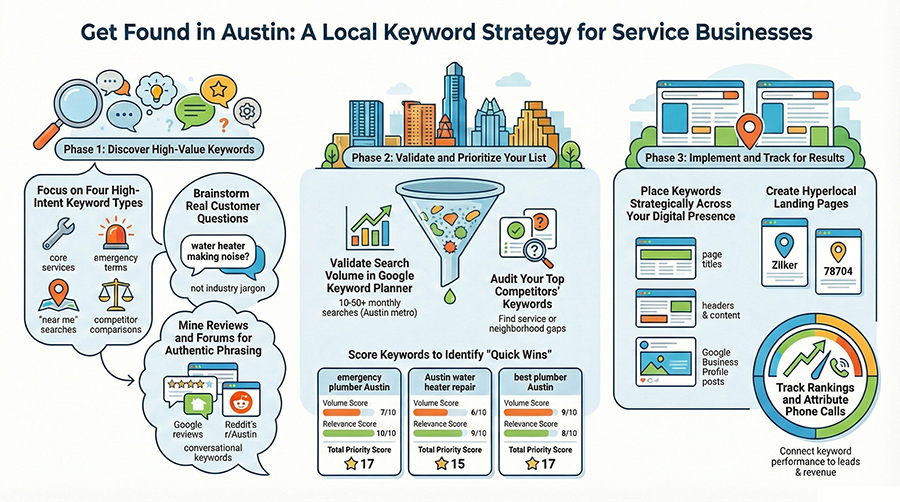
1. Brainstorm Customer Questions
Start by listing every question customers ask during sales calls, in emails, or when they first contact you. Think about the problems they’re trying to solve rather than industry jargon. Homeowners search “water heater making noise” rather than “thermal expansion tank malfunction.”
2. Extract Suggestions With Google Autocomplete
Type your base service terms into Google and record all autocomplete suggestions that appear. Google’s autocomplete reflects real search patterns from users in your area. Try variations like “[service] Austin,” “Austin [service],” and “[service] near me” to capture different suggestion sets.
3. Validate Search Volume in Keyword Planner
Use Google Keyword Planner to check monthly search volumes specifically for the Austin metro area. Set your location targeting to Austin, Texas, and the surrounding cities you serve. Focus on keywords with at least 10-50 monthly searches—even modest volumes can generate significant business for local service providers when the intent is strong.
4. Mine Reviews and Forums for Phrasing
Read through customer reviews on your Google Business Profile and those of your competitors, paying attention to the specific language people use. Local forums like Nextdoor Austin and Reddit’s r/Austin often reveal how residents discuss service needs. This research reveals conversational phrases that are not captured in traditional keyword tools but accurately reflect real search behavior.
5. Audit Competitor Pages and GBP Categories
Analyze the top three competitors’ ranking for your target keywords and note which terms they emphasize in title tags, headers, and Google Business Profile categories. Look for gaps in their coverage—services they mention briefly or neighborhoods they don’t explicitly target represent opportunities where you can establish stronger relevance.
Tools and Data Sources for Hyperlocal Keyword Discovery
The right combination of free and paid tools helps you uncover Austin-specific keyword opportunities that broader research methods miss.
Google Keyword Planner
This free tool (requires a Google Ads account) lets you set location targeting specifically to the Austin metro area. While it groups similar keywords together and provides ranges rather than exact volumes, it remains the most reliable source for understanding relative search demand. The “Get search volume and forecasts” feature shows you exactly how many monthly searches your keyword list receives in Austin.
Google Search Console
If your website is already live, Search Console reveals which keywords you’re already ranking for and how many impressions and clicks each generates. Look for keywords where you rank on page two (positions 11-20)—these represent quick wins where small improvements could move you to page one.
BrightLocal and Local Falcon
These specialized local SEO tools track your rankings across different Austin neighborhoods. Local Falcon is particularly useful for understanding how your visibility changes across different parts of Austin, since Google shows different results based on the searcher’s location.
AnswerThePublic
This visual tool organizes keyword suggestions by question words (what, why, how, when, where) and prepositions (for, with, near, without). Enter a base term like “plumber” or “HVAC” and you’ll see dozens of question-based searches that reveal customer concerns. These longer question phrases often face less competition while still attracting qualified traffic.
ChatGPT Prompts for Seed Lists
AI tools can quickly generate keyword variations you might overlook. Try prompts like “What questions do Austin homeowners ask about HVAC maintenance?” or “List common plumbing problems that Austin residents search for online.” You’ll still need to validate these suggestions with actual search volume data, but AI helps you think through different angles and customer perspectives.
Prioritizing Keywords by Intent, Volume, and Competition
Once you’ve compiled a list of potential keywords, you need a way to evaluate which ones deserve your immediate attention versus which to target later.
Scoring Matrix Template
Create a simple spreadsheet that rates each keyword on three factors: monthly search volume (1-10), competition level (1-10, with 10 being easiest), and business relevance (1-10). Add these scores together to identify your highest-priority targets.
| Keyword | Volume | Competition | Relevance | Total Score |
|---|---|---|---|---|
| emergency plumber Austin | 7 | 6 | 10 | 23 |
| Austin water heater repair | 6 | 7 | 9 | 22 |
| best plumber Austin | 9 | 3 | 8 | 20 |
This framework helps you balance opportunity with feasibility—a keyword with massive search volume but fierce competition might score lower than a more modest term where you can realistically rank.
Quick-Win Versus Long-Term Buckets
Separate your keyword list into two categories: immediate opportunities with lower competition that you can rank for within 3-6 months, and aspirational targets that require more authority and time. Focus your initial content creation and optimization on quick wins to build momentum. As your site gains authority, you’ll naturally become more competitive for higher-difficulty terms.
Neighborhood and Zip Code Modifiers Every Austin Service Should Target
Austin’s distinct neighborhoods and surrounding communities provide dozens of hyperlocal keyword opportunities that help you capture nearby customers.
Downtown and South Congress
Major Austin districts each have their own search volume and customer demographics. Target neighborhoods like Downtown, South Congress (SoCo), Zilker, East Austin, Westlake, Hyde Park, and The Domain. Each neighborhood name combines with your core services: “plumber in Zilker,” “East Austin HVAC repair,” or “Westlake landscaping services.”
78704 78745 78759
The highest-population zip codes in the Austin metro area deserve dedicated attention, as some customers search by zip code rather than neighborhood names. The most valuable zip codes for service businesses include:
- 78704: South Austin near Barton Springs
- 78745: South Austin residential areas
- 78759: North Austin near The Domain
- 78748: Southwest Austin
- 78731: West Austin and Westlake
Create service area pages targeting these specific zip codes to capture this search traffic.
Round Rock Cedar Park Pflugerville
Surrounding cities like Round Rock, Cedar Park, Pflugerville, Georgetown, and Leander have substantial populations and often face less competition. Many Austin-based service businesses serve these areas but fail to optimize for them, creating opportunities for businesses that explicitly target these communities.
Using Keywords Across Site Pages Google Business Profile and Voice Search
Discovering valuable keywords is only half the battle—strategic implementation across your digital presence determines whether you’ll actually rank for them.
1. On-Page Placement
Place your primary keyword in your title tag, H1 header, and naturally throughout your content, aiming for 2-3% keyword density without forcing it. Secondary keywords belong in H2 and H3 headers where they fit naturally. The key is writing for humans first while ensuring search engines can clearly identify your page’s topic and relevance.
2. Service-Area Landing Pages
Create dedicated pages for each major service area or neighborhood you serve, with unique content that mentions local landmarks and addresses area-specific concerns. A page titled “HVAC Repair in Round Rock TX” discusses Round Rock specifically, not just your main service page with a location name swapped in.
3. Google Business Profile Categories and Posts
Select the most specific business categories available that match your services—Google allows one primary category and up to nine additional categories. Use your target keywords in regular Google Posts (aim for weekly updates) to reinforce your relevance for local searches.
4. Conversational Phrasing for Smart Speakers
Voice search queries tend to be longer and more conversational than typed searches. Optimize for phrases like “Where can I find a reliable plumber in Austin?” or “What’s the best HVAC company near me?” by incorporating natural question-and-answer formats into your content.
Tracking Rankings Calls and Revenue to Refine Your List
Keyword research isn’t a one-time project—ongoing measurement helps you identify which keywords actually drive business results.
Rank Trackers and Call Tracking Numbers
Set up a rank tracking tool (like SEMrush, Ahrefs, or even free Google Search Console monitoring) to monitor your positions for target keywords weekly. Implement call tracking numbers on your website so you can attribute phone calls to specific traffic sources and keywords. This connection between rankings and actual leads reveals which keywords have the highest business value, not just the highest search volume.
Monthly KPI Dashboard
Create a simple spreadsheet or dashboard tracking your rankings for top 20 keywords, organic website traffic, phone calls from organic search, and conversions or revenue from organic leads. Review this monthly to identify trends—if you’re ranking well for certain keywords but not getting calls, those terms might have weak commercial intent or your landing pages need better conversion optimization.
Future-Proofing With AI and LLM Seeding for Local Search
Search is evolving rapidly with AI-powered results appearing above traditional organic listings, making it important to optimize for how large language models surface information.
What Is LLM Seeding
LLM seeding refers to optimizing your content so it’s more likely to be referenced by AI systems like ChatGPT, Google’s AI Overviews, and Bing Chat when they generate responses to user queries. These systems pull information from websites they consider authoritative and well-structured. While you can’t directly control what AI systems say about your business, you can increase your chances of being cited by creating comprehensive, well-organized content that directly answers common questions.
Prompt Ideas to Influence AI Overviews
Structure your content to answer questions completely and concisely in the first paragraph, then expand with details—this format matches how AI systems prefer to extract information. Create definitive guides on topics in your industry, use clear headers that match question formats, and include specific data points and examples. When AI systems need to answer “What’s the average cost of HVAC repair in Austin?” they’re more likely to reference a page that directly states this information clearly rather than one that dances around the topic.
Ready to Grow? Get Expert Help From Austin Code Monkey
Keyword research and ongoing optimization require significant time and expertise to execute effectively. Competing in Austin’s crowded service market often demands professional support to stay ahead of competitors and adapt to constant algorithm changes.
Call for a free SEO consultation to discuss how Austin Code Monkey can develop and execute a comprehensive keyword strategy tailored to your specific service business and growth goals.
FAQs About Austin Service Keyword Research
How often should Austin service businesses update their keyword lists?
Review your keyword strategy quarterly to capture seasonal trends, new competitor activities, and changes in search behavior. Monthly monitoring of your rankings helps you identify when adjustments are needed, but major keyword list overhauls typically make sense every three months unless you’re entering new service areas or launching new offerings.
What makes a good keyword difficulty score for local Austin service terms?
Target keywords with low to medium difficulty scores (typically under 40 on most SEO tools) when you’re starting out, as local searches generally face less competition than national terms. However, focus more on relevance and search intent than pure difficulty numbers—a slightly harder keyword that perfectly matches your service and location is often more valuable than an easy keyword that attracts the wrong audience.
How do voice search patterns differ for Austin service businesses?
Voice searches use more conversational language and complete question formats like “What’s the best plumber near downtown Austin?” rather than short phrases like “Austin plumber.” People also tend to include more qualifiers in voice searches, such as “affordable,” “highly rated,” or “open now,” because speaking feels more natural than typing abbreviated queries.
Contact Austin Code Monkey

Ready to take your business to the next level? Contact the Best Austin SEO Company For Small Business today.
-
Phone: (737) 932-7532
-
Website: https://austincodemonkey.com/
-
Hours of Operation:
-
Monday: 10:00 AM – 10:00 PM
-
Tuesday: 10:00 AM – 10:00 PM
-
Wednesday: 10:00 AM – 10:00 PM
-
Thursday: 10:00 AM – 10:00 PM
-
Friday: 10:00 AM – 10:00 PM
-
Let us handle your internet marketing so you can get back to business.