By Austin Code Monkey | Austin SEO & AI Search Optimization
If your business operates in law, finance, healthcare, insurance, or any field where your advice directly shapes someone’s life, wealth, or safety, you are operating in what Google has long called a YMYL category: “Your Money, Your Life”. These are the industries where bad information doesn’t just cost someone a click. It costs them money. It costs them their health. In some cases, it costs them their freedom.
Google has always applied stricter standards to YMYL content. But with the rapid rise of AI-powered search Google’s own AI Overviews, ChatGPT, Perplexity, Gemini, and Claude, those standards have become both more consequential and more technically demanding than most YMYL business owners realize.
The bottom line: if your website isn’t structured to prove its expertise and trustworthiness to AI search engines, you will not get cited. In trust-sensitive industries, being absent from AI-generated answers isn’t just a missed marketing opportunity. It’s a direct competitive disadvantage that will compound over time as more of your prospective clients turn to AI for guidance before they ever call your office.
AI search engines demand more than good content; they require verifiable trust. This episode covers how credentialed authors, structured schema, and consistent entity signals help YMYL businesses earn AI citations. Austin Code Monkey shares practical steps to protect and grow your digital presence.
What Is YMYL and Why Does It Matter for AI Search?
YMYL -Your Money, Your Life – is Google’s classification for industries where inaccurate information can cause serious harm to users. This includes legal services, financial advice, healthcare, civic services, safety information, and high-value e-commerce. AI search engines apply significantly higher trust thresholds to YMYL content before surfacing or citing any source, making credentialed, well-structured websites far more likely to appear in AI-generated answers than uncredentialed competitors.
Google introduced the YMYL designation to identify content categories where accuracy and credibility are critical to user wellbeing. The list includes:
- Legal services – law firms, immigration attorneys, civil rights organizations, and legal aid providers
- Financial services – banks, mortgage lenders, investment brokers, tax professionals, and insurance agencies
- Health and medical -hospitals, clinics, pharmacies, wellness centers, and nutrition or supplement providers
- Civic and government services – agencies and organizations that help people navigate laws, rights, and public services
- News and current events – outlets covering policy, civil society, and significant public issues
- Safety and emergency information – disaster preparedness, workplace safety, and product safety resources
- High-value and safety-sensitive e-commerce – stores selling car parts, electronics, dietary supplements, or other products that affect user safety
What these categories share is consequence. A user who receives inaccurate information about a medication dosage, a legal deadline, or a mortgage rate isn’t just inconvenienced — they can be seriously harmed.
AI search engines understand this. They apply significantly higher trust thresholds to YMYL queries before surfacing or citing any source. And the technical bar for meeting those thresholds is far higher than most YMYL businesses currently clear.
How Do AI Search Engines Evaluate Trust for YMYL Content?
AI search engines evaluate trust for YMYL content through three primary signals: verified credential and license schema (structured data declaring professional qualifications in machine-readable format), E-E-A-T compliance (content attributable to named, credentialed authors whose expertise is externally verifiable), and entity consistency (uniform business information across all directories, regulatory registries, and review platforms). YMYL businesses that fail to provide these signals are routinely excluded from AI-generated answers, regardless of how accurate or helpful their content is.
Traditional SEO rewarded businesses that published keyword-rich content, earned backlinks, and maintained good technical site health. Those factors still matter, but AI search adds a new layer of evaluation that is more rigorous and more unforgiving for YMYL categories.
AI engines are making trust determinations based on several signals that most YMYL websites have never been optimized to provide.
Why Do Verified Credentials and Professional Schema Matter for AI Search?
AI search engines cannot verify professional authority from plain text alone. They rely on structured data specifically schema markup — to confirm that a source holds the credentials required to give advice on medical, legal, or financial topics. A law firm with attorney bar numbers declared in schema, or a medical clinic with physician NPI numbers and board certifications marked up, is treated as a significantly more trustworthy and citable source than an identical business whose credentials exist only as unstructured text on a webpage.
When a user asks an AI chatbot whether a medication is safe to combine with another, or what their rights are during a landlord dispute, the AI will not surface answers from sources it cannot verify as authoritative. For YMYL businesses, that verification starts with structured data, specifically schema markup that declares your credentials, licenses, certifications, and professional affiliations in a machine-readable format.
A law firm whose attorneys have their bar numbers, practice areas, and jurisdictions marked up in proper schema is a dramatically more citable source than an identical firm whose website has no structured data. A medical clinic whose physicians have their NPI numbers, specialties, and board certifications declared in schema is far more likely to appear in health-related AI answers than one that merely lists doctor bios in plain text.
AI engines cannot read your wall of achievement plaques. They can only read the structured signals your website provides.
What Is E-E-A-T and How Does It Affect YMYL AI Search Visibility?
E-E-A-T stands for Experience, Expertise, Authoritativeness, and Trustworthiness Google’s framework for evaluating content quality, particularly in YMYL categories. For AI search, E-E-A-T means every piece of content must be attributable to a named, credentialed individual with a verifiable professional profile such as a state bar listing, FINRA record, or medical board entry. Anonymous or uncredited content is treated as low-trust by AI engines and is rarely cited in generated answers, even when the content itself is accurate.
Google’s quality evaluator guidelines formalized the concept of E-E-A-T years ago but AI search has operationalized it in ways that directly affect whether you get cited or ignored.
For YMYL businesses, every piece of content on your website needs to be attributable to a real, credentialed individual whose expertise is verifiable. Anonymous blog posts, uncredited “staff articles,” and generic informational pages without named authors are essentially invisible to AI search from a trust perspective.
This means every article, FAQ page, practice area description, and service page needs a named author, a credentials summary, and ideally a link to a verifiable professional profile, a state bar listing, a medical board entry, a FINRA record, and a licensed contractor registry. These aren’t optional enhancements. For YMYL categories, they are table stakes for AI citation eligibility.
How Does Entity Consistency Across the Web Affect AI Search Citations?
AI engines build a trust model of your business by cross-referencing every mention of it online your website, Google Business Profile, legal directories, regulatory registries, review platforms, and professional association memberships. When these mentions are consistent, your business is treated as a verified entity and recommended with confidence. When they are inconsistent different addresses, mismatched phone numbers, missing license numbers AI engines assign a lower trust score, which directly reduces the likelihood your business is cited in AI-generated answers.
AI engines build a model of your business based on every mention of it they can find your website, your Google Business Profile, legal directories, professional association memberships, press mentions, review platforms, and regulatory registries.
When those mentions are consistent and reinforce each other, you are treated as a verified, trustworthy entity. When they are inconsistent, different phone numbers, different addresses, inconsistent business names, or missing license numbers, that inconsistency is a trust signal in the wrong direction.
For a personal injury law firm or a mortgage brokerage, entity inconsistency doesn’t just suppress rankings. It can mean the difference between being recommended in an AI answer and being invisible to a prospective client who is ready to hire right now.
What Are the Specific Risks for Each YMYL Category in AI Search?
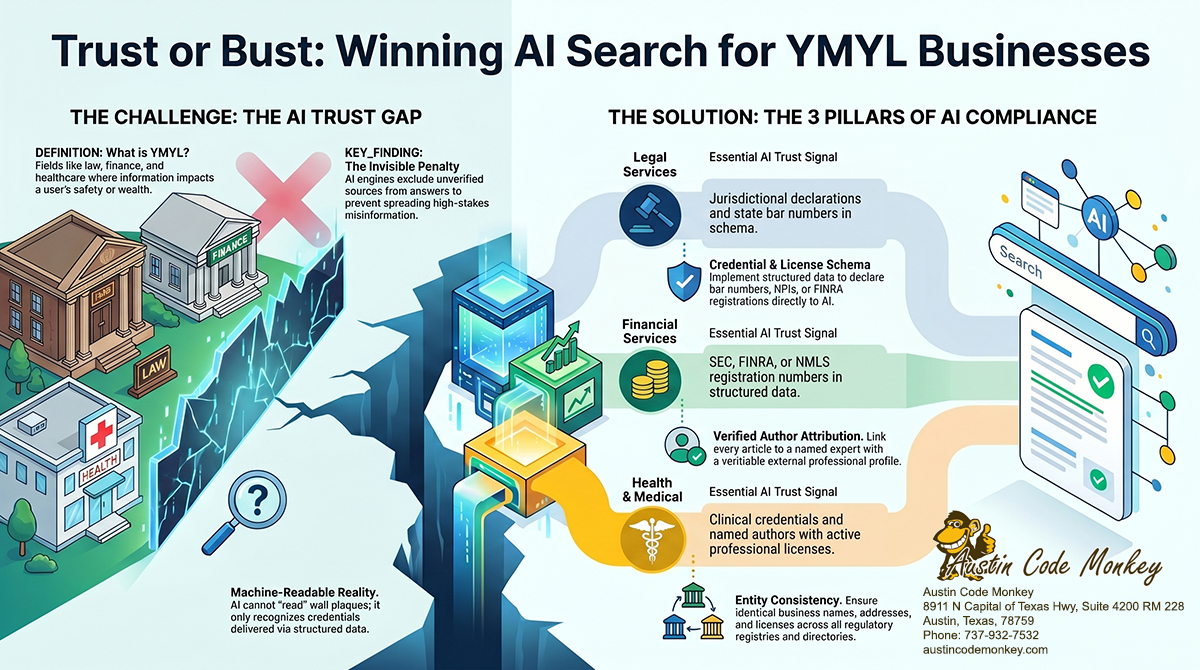
The AI search trust gap affects YMYL industries differently based on the type of credentials AI engines expect to find. Law firms risk exclusion without verifiable bar memberships and jurisdictional schema. Financial advisors risk being bypassed without SEC, FINRA, or NMLS registration in their structured data. Healthcare providers face the highest trust threshold of any YMYL category, requiring named authors with clinical credentials and up-to-date professional licenses. Safety-sensitive e-commerce businesses risk being omitted from AI recommendations without product schema and regulatory compliance signals. In every case, the businesses that fail to surface these trust signals are being passed over in favor of competitors who have.
The trust gap between a well-optimized YMYL website and a poorly optimized one is not uniform it varies by category and by how actively AI engines are filtering that category’s content.
Law firms and legal services face intense AI scrutiny because legal advice is jurisdiction-specific, high-stakes, and easily harmful if wrong. AI engines heavily favor sources with verifiable bar memberships, clear jurisdictional declarations, and content that is appropriately caveated. Firms without a proper attorney schema, or whose websites make broad legal claims without credentials backing, are routinely excluded from AI-generated legal guidance.
Financial services providers — particularly those advising on investments, taxes, or lending are evaluated against regulatory registration databases. An investment advisor whose SEC or FINRA registration isn’t reflected in their structured data is a lower-confidence citation for any AI answering a financial question. Banks and mortgage lenders without NMLS numbers in their schema are leaving critical credibility signals on the table.
Health and medical providers operate in arguably the highest-trust-threshold YMYL subcategory. AI engines are conservative to the point of caution when surfacing medical content, and they heavily favor sources with verifiable clinical credentials, institutional affiliations, and up-to-date professional licenses. A wellness center or nutrition blog whose content isn’t backed by named, credentialed authors will struggle to earn AI citations regardless of how accurate or helpful that content is.
High-value and safety-sensitive e-commerce — particularly supplement retailers, automotive parts sellers, and electronics providers — faces a different version of the same problem. Without proper product schema, safety certification markup, and transparent regulatory compliance signals, AI engines are reluctant to recommend these businesses for queries where safety is a factor.
What Does AI-Compliant Actually Look Like for a YMYL Business?
An AI-compliant YMYL website has five distinguishing characteristics: credential and license schema that declares professional qualifications in structured data; author markup that attributes every piece of content to a named, credentialed expert with a verifiable external profile; consistent entity information across all directories and regulatory registries; content architecture that leads with direct answers, uses FAQ schema, and is updated regularly for freshness; and an optimized Google Business Profile that reflects credentials, specializations, and service areas accurately. Businesses that implement all five layers are substantially more likely to be cited by AI search engines than those that rely on traditional SEO alone.
Becoming citable in AI search for a YMYL business isn’t a single fix; it’s a systematic restructuring of how your digital presence communicates trust. At Austin Code Monkey, our AI Search Optimization process for YMYL businesses addresses every layer of this:
Credential and license schema implementation. We implement structured data that explicitly declares your professional credentials, license numbers, regulatory registrations, and certifications in the formats that AI search engines parse and weight. This is the technical foundation that makes everything else possible.
Author and expertise markup. We build out author profiles for every content creator on your site with proper Person schema, credential declarations, and links to verifiable external profiles. Every piece of content is attributable to a real expert whose authority is machine-readable.
Entity consolidation and consistency audit. We audit every place your business appears online, in directories, professional registries, review platforms, and regulatory listings, and resolve inconsistencies that undermine your entity trust score. For YMYL businesses, this audit alone regularly surfaces issues that are actively suppressing AI visibility.
Compliant, AI-citable content architecture. We restructure existing content and produce new content that follows the formatting principles AI engines favor: direct answers in the first paragraph, FAQ schema on key pages, descriptive headings, appropriate professional caveats, and regular freshness updates. Content that AI engines can parse clearly is content they are willing to cite.
Google Business Profile optimization and management. For local YMYL businesses, law firms, medical practices, and insurance agencies, your GBP is a critical trust anchor. We ensure your profile reflects your credentials, specializations, and service areas accurately, and we manage it actively to keep trust signals current.
What Is the Cost of Waiting to Optimize for AI Search as a YMYL Business?
Every month a YMYL business delays AI search optimization is a month its competitors are capturing prospective clients at the highest-intent moment — when those clients are asking AI assistants questions like “what should I do after a car accident,” “is this medication safe,” or “how do I dispute a tax assessment.” AI-generated answers direct users toward specific businesses. YMYL businesses that are not structured to appear in those answers are not just missing traffic — they are actively ceding client acquisition to competitors who adapted first.
Your prospective clients are already using AI to ask questions that used to bring them to your door: “What should I do after a car accident?” “Is this medication safe during pregnancy?” “What are my rights if my landlord won’t make repairs?” “How do I dispute a tax assessment?”
The businesses that appear in those AI-generated answers are capturing client intent at the highest possible moment, right when a need is being formed. The businesses that don’t appear are ceding those moments entirely, often to competitors who were simply faster to adapt.
Trust-first AI search is not a future development. It is the environment your business is operating in right now.
How Can Austin Code Monkey Help My YMYL Business Become AI-Search Ready?
Austin Code Monkey provides a free YMYL SEO and AI readiness audit that identifies credential schema gaps, entity consistency issues, E-E-A-T deficiencies, and content compliance problems specific to your industry. From there, we build a custom AI Search Optimization strategy covering structured data implementation, author markup, entity consolidation, content architecture, and Google Business Profile management the complete technical foundation that positions YMYL businesses to be cited by Google AI Overviews, ChatGPT, Perplexity, Gemini, and Claude.
Austin Code Monkey works with YMYL businesses across Austin and throughout Texas to build an AI-compliant digital presence that earns citations, builds trust, and generates consistent inbound leads. Our free SEO audit includes a full assessment of your current AI search visibility, credential schema gaps, entity consistency issues, and content compliance, the specific factors that determine whether AI engines cite you or skip you.
You’ll leave the audit knowing exactly where you stand and exactly what needs to change.
Your credentials are real. Your expertise is established. Make sure AI search engines can see it
Austin Code Monkey’s expert team is ready to transform your online visibility and help you capture more customers across every channel where they search.
Austin Code Monkey
Phone: (737) 932-7532
Hours: Monday – Friday, 10:00 AM – 10:00 PM
Website: https://austincodemonkey.com/
Get Started Today:
- Call (737) 932-7532 for a free consultation
- Schedule your free YMYL SEO audit with Austin Code Monkey today.
- Discover how SEO and AI Search Optimization can transform your business
Don’t let your competitors dominate your business in search queries. Partner with Austin’s leading local SEO experts and ensure your business appears when and where your customers are searching. Contact Austin Code Monkey today and take the first step toward complete digital dominance in the Austin market.