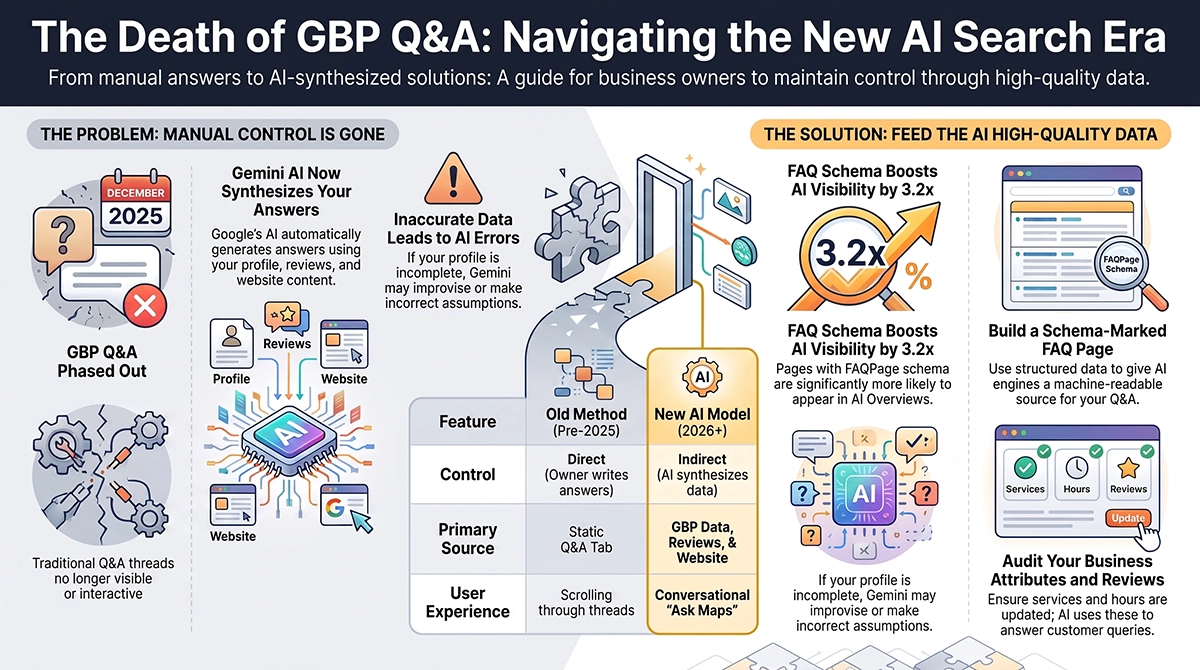
The Google Business Profile Q&A feature is effectively dead. The My Business Q&A API was discontinued on November 3, 2025, and starting December 3, 2025, Google began phasing out the public Q&A section on Business Profiles, meaning visitors to your profile will no longer see or interact with traditional Q&A threads. What replaced it is not a like-for-like swap. Google’s AI, powered by Gemini, now sources answers from your business profile’s core information, including categories, services, photos, descriptions, and reviews, as well as your website content. That is a fundamentally different model, and the controls are different too. Most GBP guides written before late 2025 still describe the old Q&A workflow, which is why this matters right now. If you are still managing questions and answers through a third-party tool, or waiting on that tab to come back, it is not coming back. Your job now is to make sure Gemini has clean, accurate information to work from, and a dedicated FAQ page on your website with proper schema markup is the most direct way to do that.

With Q&A gone, structured data has become more important than ever. This episode explains how FAQ schema markup and clean profile attributes help guide AI tools like Ask Maps and Gemini. Discover how to feed high-quality information so AI describes your business accurately.
How Gemini Now Answers Questions About Your Business
Google has rolled out a new generation of AI-driven features, most notably the conversational “Ask Maps” experience in Google Maps. Powered by Google’s Gemini large language model, this feature allows users to ask natural language questions such as “Does this place have outdoor seating?” or “Is this business good for large groups?” and receive instant summarized answers.
The key thing to understand is where Gemini pulls those answers from. Answers are no longer written by the business owner in a visible Q&A box. Instead, Gemini synthesizes answers automatically using multiple data sources, including your Google Business Profile data such as hours, services, attributes, and amenities, customer reviews including sentiment and recurring themes, and structured website content, especially FAQ pages marked up with FAQ schema.
This shift has a direct consequence for accuracy. If your GBP profile is incomplete or outdated, Google’s AI will work with limited information and may make incorrect assumptions about your business. For example, if you do not list a specific service, the AI may tell customers you do not offer it. The old Q&A section at least let you write your own answers. Now the answers are generated, and the quality of those answers depends entirely on the quality of the inputs you have given Google to work from. Industry data published in mid-2026 shows that pages with FAQPage schema are 3.2 times more likely to appear in Google AI Overviews than pages without it, which gives you a concrete sense of how much structured content actually moves the needle when an AI is deciding what to surface.
Search is moving away from static, one-size-fits-all information toward more conversational, AI-driven experiences, and this deprecation is one of the cleaner signals of that direction. The Q&A API deprecation follows the July 31, 2024, discontinuation of the Google Business Profile chat feature, indicating Google’s strategic focus on specific communication channels. The pattern is consistent: Google is retiring features it built for humans to manage manually and replacing them with features Gemini manages automatically.
What This Actually Means If You Own a Local Business
The practical shift is this: you used to control your GBP narrative by writing Q&A answers yourself. Now you influence it indirectly by feeding Gemini better data than it could piece together on its own. That requires a different kind of attention.
Start with your GBP profile itself. The accuracy and completeness of your GBP profile directly impacts what customers learn about your business. Go through every field: services, business description, attributes, hours, photos, and fill in anything that is missing or vague. If the information is missing or inconsistent, Gemini will either skip the answer or infer it from user content, which can lead to errors. Errors at the Gemini level are worse than a blank Q&A section, because they look authoritative.
Next, build a dedicated FAQ page on your website. This is now the primary mechanism you have for shaping what Gemini says about you. Write out the questions your customers actually ask, answer them directly and specifically, and mark the page up with FAQPage schema. Schema markup is not a SERP decoration tactic anymore. It is a machine-readability layer, and that function has become more relevant as AI search engines that depend on fast, accurate content classification have grown. One important nuance worth knowing: Google deprecated FAQ rich results on May 7, 2026, ending the expandable Q&A dropdown feature that had appeared in search listings, following a three-year rollback that had already restricted them. So FAQ schema no longer earns you a visual dropdown in search results. What it does do is give Gemini and other AI engines a structured, machine-readable signal about your content. ChatGPT Search, Perplexity, and Gemini all parse FAQ structured data as a primary extraction source for Q&A answers. That is where the value is now.
Finally, watch your reviews. Gemini weighs review sentiment and recurring keywords as part of its synthesis. A cluster of reviews mentioning a specific service, or a specific complaint, will shape the answers Gemini gives, whether you want it to or not.
A Practitioner’s Take on Getting This Right
Most of the guides published in the wake of the Q&A deprecation focus on the GBP side of this problem: fill in your attributes, update your description, respond to reviews. That is all correct and necessary. What gets skipped is the website side, specifically the argument for treating your FAQ page as an active training layer for Gemini rather than a passive informational page.
The framing that Austin Code Monkey uses with clients is this: your FAQ schema page is your new Q&A section, except it lives on your website where you have full editorial control, and it feeds every AI engine simultaneously, not just Google Maps. That reframe changes how you write the content. Instead of broad, generic questions like “What services do you offer?”, you write the specific, conversion-relevant questions that show up in discovery. “Do you serve clients in [city]?” “What is your turnaround time for [specific service]?” “Is a deposit required?” Those are the questions Gemini fields when someone taps “Ask about this place” on your Maps listing. If your FAQ page answers them clearly and the schema is implemented correctly, you are handing Gemini a ready-made, accurate answer. If you are not doing this, Gemini is improvising from whatever partial data it can find.
Austin Code Monkey’s approach layers FAQ schema on top of LocalBusiness and Service schema so that the entity context is established before the Q&A content even begins. That layering matters because Gemini is not just reading one page in isolation. It is building a picture of your business from multiple sources, and the more consistent and structured those sources are, the more confidently it will answer on your behalf.
Frequently Asked Questions
Is the Google Business Profile Q&A section completely gone?
What is Google using to answer customer questions about my business now?
Does FAQ schema on my website still matter after Google deprecated FAQ rich results in 2026?
Want a Second Set of Eyes on How Gemini Sees Your Business?
If you are not sure what Gemini is currently saying when someone asks about your business, or if your FAQ page and schema setup are actually doing any work, that is worth a quick look before it costs you customers. The team at Austin Code Monkey reviews GBP data consistency, website schema implementation, and AI answer accuracy for local and regional businesses. No pressure, just a clear read on where the gaps are. Reach out at 737-932-7532 or visit austincodemonkey.com to get started.
Call 737-932-7532 or visit austincodemonkey.com to schedule your free audit. We’ll have you ranking higher and generating more leads within 30 days. El Jefe of SEO doesn’t make promises we can’t keep.
Still have questions?
The “rules” of local search are being rewritten in real-time. Austin Code Monkey specializes in “feeding the AI,” ensuring your business data is structured, verified, and descriptive enough for Gemini to choose you over the competition.
Contact us today to run an “AI Visibility Audit” and see how your business appears in the new Ask Maps world.
Austin Code Monkey
Phone: (737) 932-7532
Hours: Monday – Friday, 10:00 AM – 10:00 PM
Website: https://austincodemonkey.com/
Get Started Today:
- Schedule your complimentary SEO audit
- Discover how SEO and AI Search Optimization can transform your business
Don’t let your competitors dominate your business in search queries. Partner with Austin’s leading SEO company and ensure your business appears when and where your customers are searching. Contact Austin Code Monkey today and take the first step toward complete digital dominance in the Austin market.