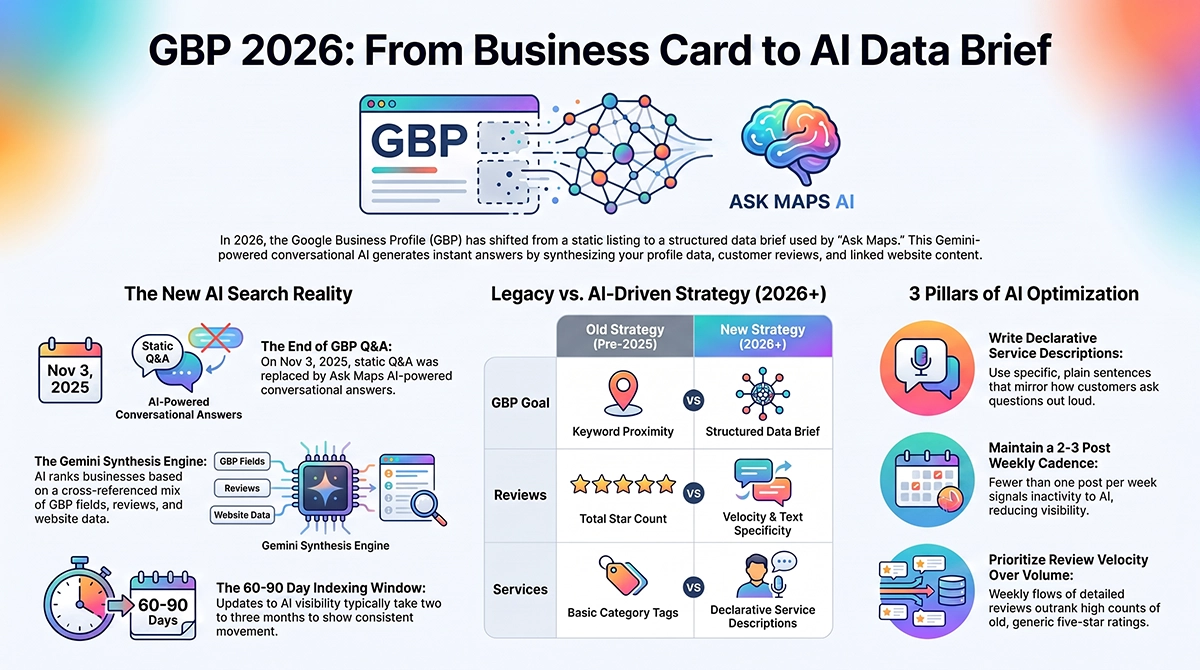
Your Google Business Profile needs to function less like a business card and more like a structured data brief that an AI can read, parse, and cite on demand. That shift is not theoretical. In late 2025, Google officially discontinued the GBP Q&A section, replacing it with Ask Maps, a Gemini-powered conversational feature that generates instant answers about your business from your profile data, your reviews, and your website. The Q&A API was discontinued on November 3, 2025, and the public-facing section has been gradually removed from listings since then. Most GBP optimization advice floating around online was written before any of this happened. It still talks about seeding Q&A with pre-written answers, optimizing for the local 3-pack, and completing a checklist of basic fields. That advice is not wrong so much as it is incomplete. The actual question now is not whether your profile is filled out, but whether Gemini can extract specific, confident answers from it when a real customer asks a real question inside Google Maps.
Google Business Profiles are no longer just digital listings; they’re now feeding AI answers. This episode explores the major shift to Gemini-powered systems like Ask Maps, where reviews, service details, and website content are synthesized into conversational recommendations. Discover why businesses must adapt quickly to stay visible.
How Ask Maps Actually Reads Your Profile (and Where Profiles Break Down)
Ask Maps is not a keyword-matching engine. When a user asks Google Maps something like, which plumber near me offers emergency service after 10 pm, Gemini does not scan your category and call it a day. It synthesizes data across three sources in order of priority: your GBP listing fields, your customer reviews, and your linked website. Industry data published in early 2026 found that profiles with complete data and high review volume produced significantly more accurate and favorable Ask Maps answers than profiles with sparse or missing information.
The mechanism matters. Gemini is reading for facts it can use to match a specific conversational query. That means the service descriptions you write need to be declarative and specific, not vague. A service listed simply as Haircut gives the AI almost nothing to work with. The same service written as Women’s haircut includes consultation, wash, cut, and blow-dry, specializing in curly and textured hair gives it multiple matchable attributes. The difference shows up when a customer types, who near me does curly haircuts?
Attributes play a parallel role. Ask Maps uses your selected attributes to answer direct questions like, does this place have outdoor seating? or is this business women-owned? If the attribute is not checked, the AI either skips your business or, worse, generates an inaccurate answer based on a review that mentions it in passing. That second scenario is the profile gap that produces AI misinformation: a customer writes, loved the patio, in a review, Gemini infers outdoor seating exists, but the hours, capacity, and reservation requirement are all absent because no attribute or service description covers them. The AI gives a confident-sounding answer that is only partially true, and the customer shows up expecting something different.
There is also a cross-referencing layer. Google now checks your GBP against your linked website. If your profile claims you offer a service that your website never mentions, your credibility signal for that service takes a measurable hit in how the AI weights your profile when generating recommendations.
What This Actually Means If You Own or Run a Local Business
The practical shift is this: you can no longer manage your GBP passively. The old model- claim the profile, fill in the basics, respond to the occasional review- worked because keyword proximity did most of the heavy lifting. Ask Maps changes the calculus. Gemini is now acting as the intermediary between a customer’s question and your business. You are not in that conversation unless you have given the AI enough structured, specific content to represent you accurately.
On service descriptions: every service you offer should have a written description, not just a name. Write them in plain, declarative sentences that mirror how a customer would ask about that service out loud. Think about what a customer would type into Ask Maps and work backward into the description you write. A law firm can list flat-fee packages as products. A salon can list menu items with prices. A digital agency can list service tiers. The Products tab in GBP is one of the most overlooked fields right now, and Ask Maps pulls directly from it when a user asks whether a nearby business carries or offers a specific thing.
On reviews: review velocity now matters more than total review count. Research published in 2026 found that a business with 80 reviews and a steady weekly flow of new ones outranked a competitor sitting on 200 reviews with no recent activity. Beyond volume, review content is what Gemini actually reads. A review that says, the outdoor seating area is quiet and shaded, great for working, teaches the AI something a five-star emoji review never could. Coach your customers to write about specific services, outcomes, and attributes. That is not gaming the system. That is giving the AI accurate material to work with.
On posting cadence: platforms tracking GBP performance in 2026 suggest that two to three posts per week is the optimal range. Fewer than one post per week signals inactivity to AI systems. Posts are not just marketing content anymore. They are structured data points that keep the AI’s understanding of your business current. A post announcing seasonal hours, a new service, or a specific offering is a fresh data point Gemini can use the next time someone asks a relevant question.
On website alignment: build a proper FAQ page on your site and mark it up with LocalBusiness schema. Your website functions as the verification layer. When Gemini generates an answer from your GBP, it checks your site to confirm the information. If your site is silent on a topic, the AI’s confidence in answering that question drops, and so does your likelihood of appearing in the recommendation.
Where Hands-On GBP Audit Work Actually Makes a Difference
Most business owners do not find out their profile has a problem until they manually search Ask Maps from a customer’s perspective and see what the AI actually says. Sometimes it is accurate. Sometimes it is pulling a detail from a two-year-old review and presenting it as current fact. Sometimes the business simply does not appear at all because the service descriptions are too thin for Gemini to match the query with confidence.
This is where Austin Code Monkey does its real work. The Austin Code Monkey team spends a significant portion of their GBP engagements on what most agencies skip entirely: the service-level descriptions, the attribute audit, the review language analysis, and the website schema alignment check. These are the fields that determine what Ask Maps says about a business, and they require someone who understands what Gemini is actually pulling from and why. The difference between a profile that shows up in conversational AI results and one that does not is almost never the category or the business name. It is almost always in the detail fields that most owners left at their defaults in 2022 and never touched again.
Austin Code Monkey also tests profiles actively by running Ask Maps queries in the relevant service area and comparing what the AI says against what the business actually offers. When there is a gap, they close it with specific edits, not generic rewrites. If you are managing a GBP for a multi-location business or a service area business without a storefront, the complexity increases further, and the room for profile gaps that generate AI misinformation grows proportionally.
One data point worth flagging: research published in mid-2026 found that AI-surface metrics like Ask Maps visibility typically take sixty to ninety days to show consistent movement after optimization, because AI systems need time to re-index and re-evaluate updated profile data. That lead time is a reason to start now, not a reason to wait.
Frequently Asked Questions
What replaced the Google Business Profile Q&A section?
Does Google’s AI actually read review text, or just the star rating?
How often should I post to my Google Business Profile in 2026?
Want a Second Set of Eyes on Your GBP Before Ask Maps Misrepresents You?
If you read this and realized your service descriptions are thin, your attributes are half-checked, or you have never actually tested what Ask Maps says about your business when a customer asks a real question, that is a fixable problem. It just takes someone who knows where to look and what to change. Austin Code Monkey works specifically on GBP optimization for AI-era visibility, including Ask Maps audit and alignment work. Reach out at 737-932-7532 or visit austincodemonkey.com to get a straight answer on where your profile stands and what it would take to close the gaps.
Call 737-932-7532 or visit austincodemonkey.com to schedule your free audit. We’ll have you ranking higher and generating more leads within 30 days. El Jefe of SEO doesn’t make promises we can’t keep.
Still have questions?
The “rules” of local search are being rewritten in real-time. Austin Code Monkey specializes in “feeding the AI,” ensuring your business data is structured, verified, and descriptive enough for Gemini to choose you over the competition.
Contact us today to run an “AI Visibility Audit” and see how your business appears in the new Ask Maps world.
Austin Code Monkey
Phone: (737) 932-7532
Hours: Monday – Friday, 10:00 AM – 10:00 PM
Website: https://austincodemonkey.com/
Get Started Today:
- Schedule your complimentary SEO audit
- Discover how SEO and AI Search Optimization can transform your business
Don’t let your competitors dominate your business in search queries. Partner with Austin’s leading SEO company and ensure your business appears when and where your customers are searching. Contact Austin Code Monkey today and take the first step toward complete digital dominance in the Austin market.