Generative engine optimization (GEO) is the practice of structuring your content so that AI platforms like ChatGPT, Perplexity, Gemini, and Google AI Overviews choose it as a trusted source when generating answers. Traditional SEO is the practice of earning high rankings in search engine results pages so users click through to your site. Both are about visibility, but they measure success in completely different ways and reward completely different behaviors from your content.
This distinction matters right now because the two disciplines are increasingly diverging in practice. Research published across 2025 and 2026 shows AI referral traffic growing hundreds of percent year over year while traditional organic click-through rates fall simultaneously. Gartner data shows that 35% of Gen Z now turns to AI tools first for research, compared to 7% of Gen X. New platforms, conferences, and entire agencies have been built specifically around GEO since 2023, when Princeton researchers first defined the term in a foundational paper. Business owners and marketers who built their visibility strategy entirely on rankings are now discovering that a competitor they have never seen in Google results is showing up inside the AI answer their prospects trust.
The search landscape is evolving rapidly. This episode explores the rise of Generative Engine Optimization (GEO) and how it differs from classic SEO by focusing on AI citations rather than just clicks. Learn why AI-referred traffic converts better and how businesses can adapt with structured data and concise answer blocks.
How GEO and SEO Actually Work: The Mechanism Behind Each
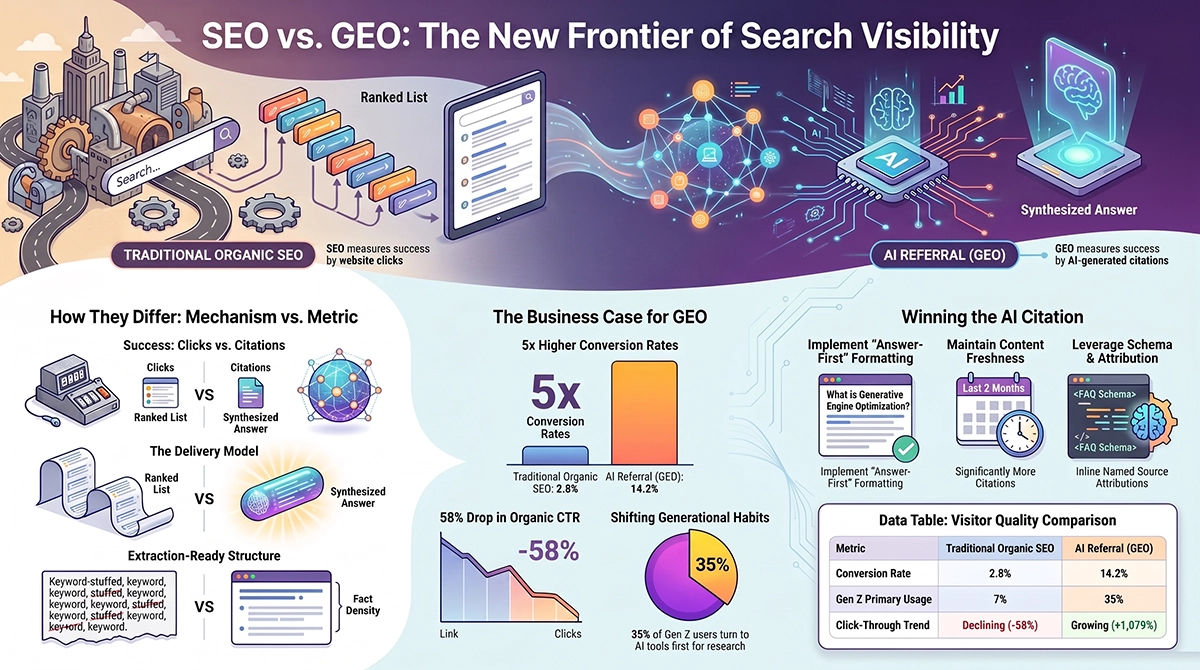
Traditional SEO is built on a crawl-and-rank model that has been refined for over two decades. Search engines use bots to discover and index content, then score it against hundreds of signals including keywords, backlinks, page speed, mobile usability, and user engagement. The goal is a high position on a results page. A user sees that position, clicks, and lands on your site. The success metric is the click.
GEO operates on an entirely different architecture. Large language models are trained on massive datasets and use transformer-based systems to interpret the intent behind a question, synthesize information from multiple sources, and generate a single coherent answer. They do not produce a ranked list of links for the user to choose from. They produce one response, sometimes with citations, sometimes without. The success metric is the citation, not the click.
This structural difference explains why the same content can rank number one on Google and generate zero AI referral traffic. A study examining AI referral patterns found that a page ranking first organically may contribute no AI referral sessions at all if its content is not structured for extraction by a language model. AI systems evaluate content differently: they look for clean, self-contained answer blocks, fact density with named sources, question-based headings, and semantic clarity rather than keyword repetition.
The behavioral shift driving all of this is measurable. Industry data published in 2026 shows that approximately 5.6% of all U.S. searches were already being conducted through AI-powered tools as the primary search interface as of mid-2025, according to reporting in the Wall Street Journal. Gartner projects that up to 25% of searches will move to generative engines by 2028. Meanwhile, Ahrefs research found that AI Overviews embedded in Google results reduced click-through rates for top-ranking organic content by 58%, a sharp jump from 34.5% the prior year. The mechanism that once connected good content to traffic is getting shorter with every model update.
What This Actually Means for Your Business: Practical Differences in How You Win
The clearest practical difference between GEO and SEO is where you show up and what happens when you do. In traditional SEO, you earn a position on a results page and compete with nine or more other results for the user’s click. In GEO, the AI selects two or three sources to synthesize and reference in a single answer. If you are not in that answer, you do not exist for that query, regardless of how well you rank on Google.
The conversion data makes this consequential in dollar terms. Multiple independent studies published in 2025 and 2026 point in the same direction on visitor quality. The Opollo AI Search Benchmark Report analyzed GA4 and CRM data from 312 B2B technology companies and found that AI-referred visitors converted at an average of 14.2%, compared to 2.8% from Google organic, roughly a fivefold difference. Adobe Analytics, examining more than one trillion visits to U.S. retail sites, found that AI-referred shoppers converted 42% better than non-AI traffic in March 2026. Across 94 ecommerce brands tracked over a full year, Visibility Labs found ChatGPT referral traffic converting 31% higher than non-branded organic search, and that same ChatGPT traffic grew 1,079% across the study period while non-branded organic grew 17%.
The reason for the conversion premium is not mysterious. An AI-referred visitor has already received a synthesized recommendation before they clicked. They arrive on your site closer to a decision than a typical search visitor who is still scanning options. They spend more time on-site and browse more pages per session. The AI functioned as a pre-qualifying filter.
The practical implication is a measurement problem as much as a content problem. AI referral traffic currently represents roughly 1% to 2% of total sessions for most sites, so it is easy to ignore in aggregate reporting. But measuring it inside your organic bucket obscures a conversion rate that, depending on your industry, may be running three to five times higher than your organic average. You need separate GA4 segments for AI referral traffic, and you need to track citation appearances in AI answers, not just keyword rankings, to understand whether your GEO program is working.
Where an Integrated SEO and GEO Approach Fits Into This
One thing worth stating plainly before getting into strategy: traditional SEO and GEO share more infrastructure than most people realize. Research tracking Google AI Overviews found that nearly 40% of AI Overview citations come from pages already ranking in the top 10 organic results, and nearly 70% come from pages ranking in the top 100. Authority, structured content, and E-E-A-T signals matter in both disciplines. Strong SEO builds the foundation that GEO builds on top of.
That said, the two disciplines diverge in meaningful ways that require deliberate attention. GEO demands content structured for extraction: short, self-contained answer blocks at the top of each section, FAQ schema, named source attribution inline in the text rather than buried in hyperlinks, and consistent brand entity presence across third-party platforms, not just your own site. AI systems pull from forums, reviews, industry publications, and social platforms when deciding what to cite. Your website alone is not enough.
Austin Code Monkey has been working at the intersection of traditional SEO and AI search optimization since GEO became a distinct discipline, and the practical reality the team at Austin Code Monkey has found is this: businesses that treat GEO as a separate project from SEO waste effort. The content signals that earn AI citations, clear authority, evidence density, direct answers, and topical depth, are the same signals that improve organic rankings when applied correctly. The difference is execution. You have to be deliberate about structuring content that an AI system can extract cleanly, and you have to measure citations and AI referral conversion rates as first-class metrics alongside your rankings report. Austin Code Monkey builds that integrated tracking into every engagement because clients need to see the full picture of where their visibility actually lives in 2026.
Frequently Asked Questions
Does GEO replace SEO?
How do you measure GEO success if there are no rankings to track?
What makes content more likely to be cited by AI engines?
Want a Second Set of Eyes on How Your Content Performs in AI Search?
If you are not sure whether your current content would be cited in an AI answer about your business, that is a useful question to have answered before your competitors do. Austin Code Monkey works with business owners and marketing teams to audit existing content for AI citation readiness, build integrated GEO and SEO strategies, and set up the analytics tracking needed to measure what is actually happening across both channels. No pitch, just a straight assessment of where you stand. Reach us at 737-932-7532 or at austincodemonkey.com to set up a conversation.

Call 737-932-7532 or visit austincodemonkey.com to schedule your free audit. We’ll have you ranking higher and generating more leads within 30 days. El Jefe of SEO doesn’t make promises we can’t keep.
Do you still have questions?
The “rules” of local search are being rewritten in real-time. Austin Code Monkey specializes in “feeding the AI,” ensuring your business data is structured, verified, and descriptive enough for Gemini to choose you over the competition.
Contact us today to run an “AI Visibility Audit” and see how your business appears in the new Ask Maps world.
Austin Code Monkey
Phone: (737) 932-7532
Hours: Monday – Friday, 10:00 AM – 10:00 PM
Website: https://austincodemonkey.com/
Get Started Today:
- Schedule your complimentary SEO audit
- Discover how SEO and AI Search Optimization can transform your business
Don’t let your competitors dominate your business in search queries. Partner with Austin’s leading SEO company and ensure your business appears when and where your customers are searching. Contact Austin Code Monkey today and take the first step toward complete digital dominance in the Austin market.