TL;DR: Google search rankings have been unusually volatile since August 1, 2026, with no confirmed update behind it. If your traffic dropped this week, checking your rank position only answers half the question. The other half is whether you’re still showing up inside the AI Overview, because that’s worth more traffic than the position itself.
What Actually Happened Between August 1 and 3
Third-party tracking tools including Semrush Sensor, AccuRanker, Mozcast, and Sistrix all spiked at the same time starting Saturday, August 1. Search Engine Roundtable’s Barry Schwartz was among the first to flag it, and by August 3 the movement was still going. Google hasn’t listed a ranking incident on its Search Status Dashboard for those dates, and the last confirmed change was the June 2026 spam update. So this one sits in the same bucket as the July 24 shuffle and the volatility around July 18 and 19: real movement, no official cause.
A few SEOs also noticed something specific during this window. YouTube videos got pushed higher in a lot of results. That’s worth watching if you’re in a space where video content exists, because it means the pages you’re competing against for a spot might not be websites at all.
Google is changing how people find information, and traditional SEO is no longer sufficient. This episode outlines why businesses must focus on making content AI-friendly and how AI Search Optimization can protect and grow visibility.
Two Different Problems That Look Identical in Search Console
Here’s the part that trips people up. A rank drop and a citation loss show up looking almost the same in your analytics: fewer clicks, less traffic, a graph pointing down. But they’re not the same problem, and they don’t have the same fix.
If your rank position moved, that’s classic SEO. Something in your content, links, or technical setup changed relative to competitors, or Google’s algorithm reweighted a signal.
If your position held steady but your traffic still dropped, the more likely explanation in 2026 is that an AI Overview started appearing on that query, or Google’s summary started citing a different source than you. Your rank didn’t fail. Your visibility inside the answer box did.
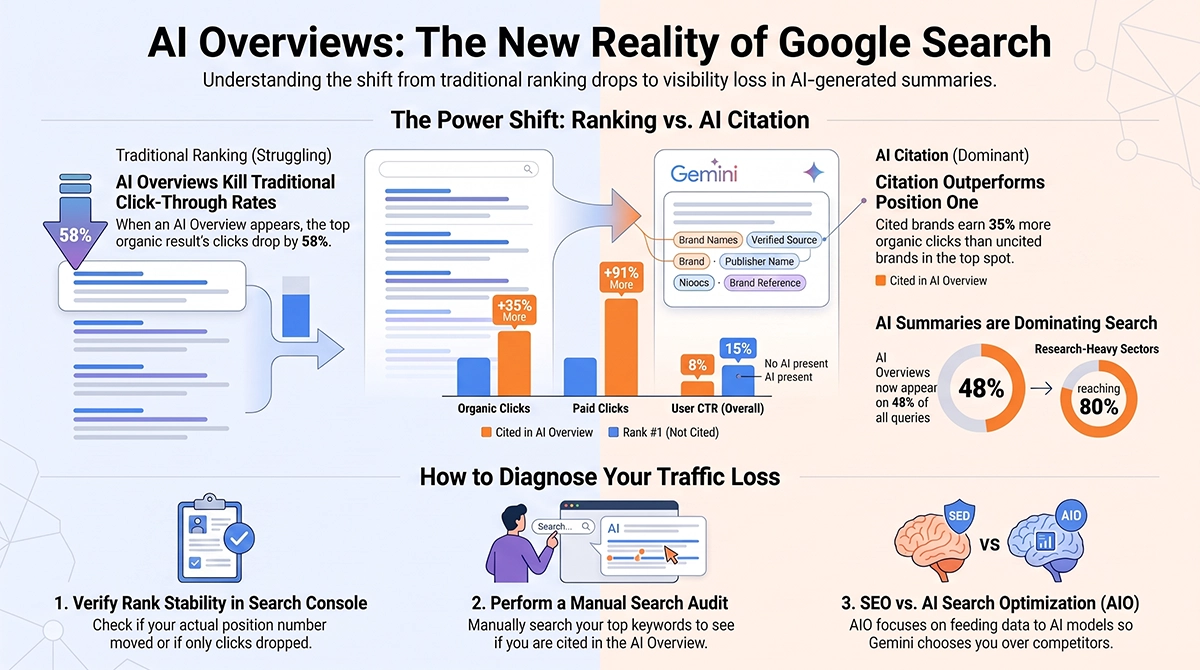
Ahrefs found that when an AI Overview appears above the number one result, that top result’s click-through rate drops by 58%. Pew Research measured a similar pattern from the user side: people click an organic result 15% of the time when there’s no AI Overview, and only 8% of the time when there is one. Neither of those numbers has anything to do with your rank position. They’re both about whether the AI Overview is standing between the user and your website.
Why Citation Is Worth More Than Position Right Now
Here’s the number that actually matters for deciding what to do next. Seer Interactive’s research found that brands cited inside an AI Overview earn 35% more organic clicks and 91% more paid clicks than brands sitting in position one underneath an AI Overview that doesn’t mention them. Being ranked first and being invisible inside the summary is now a worse spot than being ranked lower but quoted.
AI Overviews aren’t a fringe feature anymore either. BrightEdge tracked them appearing on 48% of monitored search queries as of February 2026, and that number climbs closer to 80% for health, education, and research-related searches. If your industry touches any of those categories, you should assume an AI Overview is showing up on your most important keywords whether you’ve checked or not.
How to Check Which Problem You Actually Have
Before you touch anything on your site because of this week’s shuffle, separate the two questions:
- Pull your Search Console position data for your top 10 pages over the last two weeks. Did the actual rank number move, or just the click count?
- Manually search your five most important keywords right now and look at the results page. Is there an AI Overview? Are you cited in it, cited but buried, or missing entirely?
- If your position held but clicks dropped, that’s a citation problem, not a ranking problem, and no amount of traditional on-page tweaking is going to fix it.
- If your position actually moved, then this week’s volatility (or something on your own site) is worth investigating the normal way.
Most business owners only ever run the first check. The second one is where the real answer usually is right now.
What This Means for Your Business
Traditional SEO and AI Search Optimization are two different disciplines that happen to share a lot of the same starting materials. If your site isn’t showing up when people ask ChatGPT or Google’s AI Overview about your industry, that’s an AI Search Optimization problem, not a traditional SEO one. That’s exactly the gap we close.
FAQ
Did Google confirm an algorithm update for August 2026?
No. As of this writing, Google’s Search Status Dashboard shows no confirmed ranking incident for August 1 through 6, even though third party trackers registered a clear spike starting August 1.
How do I know if I lost rankings or lost AI Overview citation?
Check your Search Console position data first. If your rank number didn’t move but clicks dropped, search your own keywords manually and look for an AI Overview. A citation loss looks like a traffic drop with a stable rank.
How much does an AI Overview reduce clicks to the top ranked page?
Ahrefs measured a 58% click through rate reduction for the number one organic result when an AI Overview appears above it.
Is it worth more to rank first or to be cited in the AI Overview?
Being cited. Seer Interactive found cited brands earn 35% more organic clicks and 91% more paid clicks than uncited brands sitting in position one.
Should I make changes to my site because of this week’s volatility?
Not immediately. Unconfirmed volatility windows have been happening roughly monthly since June 2026. Diagnose first: separate position changes from citation changes before you touch anything.
Still have questions?
The “rules” of search are being rewritten in real-time. Austin Code Monkey specializes in “feeding the AI,” ensuring your business data is structured, verified, and descriptive enough for Gemini to choose you over the competition.
Contact us today to run an “AI Visibility Audit” and see how your business appears in the new Ask Maps world.
Austin Code Monkey
Phone: (737) 932-7532
Hours: Monday – Friday, 10:00 AM – 10:00 PM
Website: https://austincodemonkey.com/
Get Started Today:
- Schedule your complimentary SEO audit
- Discover how SEO and AI Search Optimization can transform your business
Don’t let your competitors dominate your business in search queries. Partner with Austin’s leading SEO company and ensure your business appears when and where your customers are searching. Contact Austin Code Monkey today and take the first step toward complete digital dominance in the Austin market.