TL;DR: Google released its September 2026 spam update on September 24, its fourth spam update of the year and the second in roughly five weeks. The August update hit programmatic and AI-padded sites hard, and spam updates can hit a whole domain, so a batch of weak template pages can drag down the pages that actually bring in business. Use the two-week rollout window to find the pages that only exist because a template could produce them, then decide which ones earn their place.

Google’s latest spam update is cracking down on low-quality, mass-produced content and programmatic pages. This episode breaks down how the rollout affects AI-generated filler and templated websites, and why unique value and human oversight now matter more than ever.
What did Google release on September 24, 2026?
Google’s September 2026 spam update started rolling out on September 24, 2026, applies globally in all languages, and may take up to two weeks to finish.
That’s straight from Google’s Search Status Dashboard. Google didn’t say what specific spam behavior this one targets, which is normal for spam updates and also mildly annoying. It’s the fourth spam update Google has announced in 2026, and the last one wrapped up on August 21.
So nobody knows exactly what this update is aimed at yet. Anyone telling you otherwise this week is guessing. What we do have is a pretty clear picture of what the August update went after, and Google doesn’t usually run two spam updates five weeks apart because it ran out of things to do.
How hard did the August 2026 spam update hit?
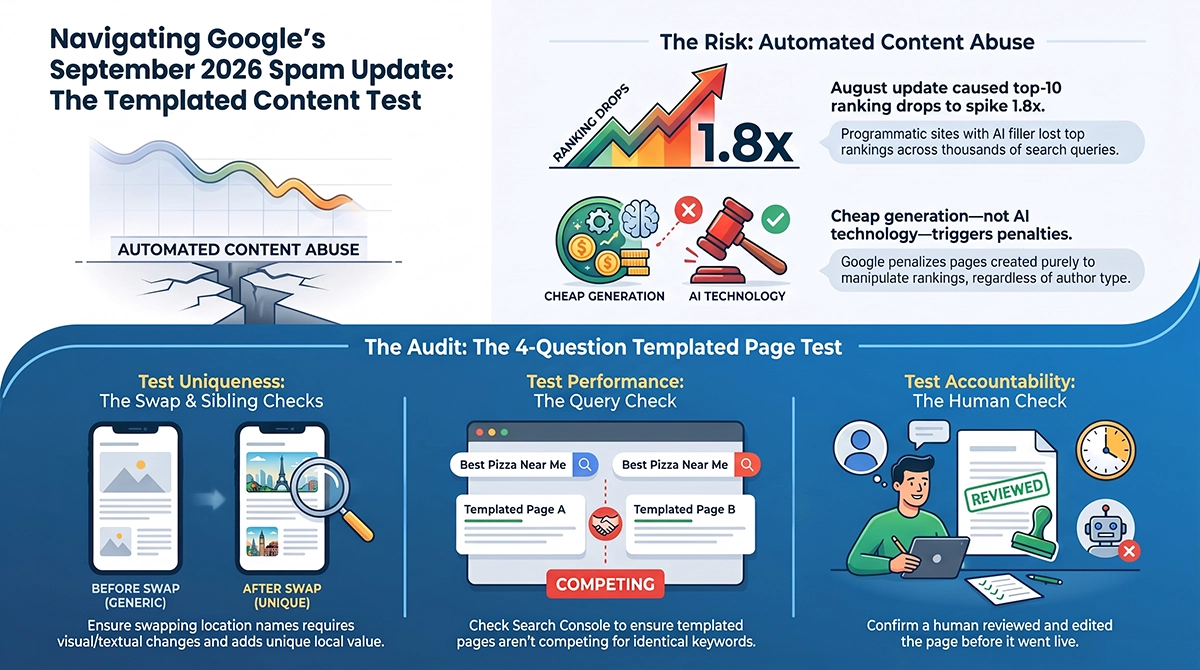
The August 2026 spam update made top-10 rankings roughly 1.8 times more likely to fall out of the top 100 than a normal week.
SE Ranking tracked 100,000 U.S. keywords across 20 industries. During the August rollout, 16.71% of URLs that had been in the top 10 dropped past position 100 for the same keyword. In a comparable five-day stretch in July, that number was 9.2%. The August update also moved fast, finishing in about two days and 16 hours.
SE Ranking was upfront that its data doesn’t show which kinds of sites got hit. For that, you have to look at case studies.
Who actually got hurt in August?
The sites that got hit hardest in August ran programmatic content at scale, padded it with AI-generated filler, and needed almost no human involvement to operate.
Glenn Gabe at GSQI published case studies on sites hit by the August update. The patterns were consistent. One large site had around 1.5 million indexed URLs, roughly 85% of them programmatic. An affiliate site built on a turnkey programmatic setup lost around 14,000 queries entirely. A YMYL site mixing programmatic pages with AI-generated chunks lost rankings for more than 200,000 queries.
The common thread wasn’t “used AI.” It was pages that didn’t need a person to exist, didn’t say anything you couldn’t get elsewhere, and got stapled together with AI text to look substantial. Gabe also notes that recovery isn’t quick. Sites have to clean up and stay clean for several months before Google’s systems notice.
Is AI-generated content itself the problem?
AI-generated content isn’t the problem; pages that exist only because they were cheap to make are the problem.
Google’s scaled content abuse policy targets content produced at scale mainly to manipulate rankings, whether a person, a script, or a model wrote it. Here’s the part I think most people get backwards. Businesses keep asking “will Google detect that we used AI?” when the real question is “would this page exist if a template couldn’t spit it out for free?”
If the honest answer is no, that page is a liability whether a human typed it or not. And because spam systems can hit a site broadly, that liability doesn’t stay on the weak page. It bleeds onto the service page that actually converts.
The 4-question test for every templated page
Any page generated from a template should pass four checks, and a page that fails two or more is a candidate to consolidate, rewrite, or cut.
1. The swap test. Replace the city, product, or service name with a different one. If nothing else on the page needs to change, it’s a doorway page wearing a nicer outfit.
2. The sibling test. Would a visitor on this page get something they couldn’t get on its nearest sibling page? Local pricing, a real project photo, a specific permit rule, an actual customer from that area. If not, the two pages are competing for the same job.
3. The query test. Open Search Console, filter by page, and look at the queries. If two of your pages keep ranking for the same terms and trading positions back and forth, that’s cannibalization, and you’re splitting your own signals.
4. The human test. Can you name the person who read this page before it went live and changed something? If nobody touched it, Google has no reason to think anyone stands behind it.
What this means for your business
If you’ve been sold, or have built, an AI content setup that pumps out location or service pages, this update is the moment to check whether a human is actually steering it.
We’re living this one at ACM right now. We’re working through keyword cannibalization across 34 of our own city pages, the exact judgment-heavy mess programmatic content creates when nobody’s managing it. The pages weren’t spam. They just overlapped enough that they started competing with each other, and that kind of overlap is what pushes a site toward the risk zone as it scales. We restructured our /who-we-help/ section into a three-tier hub so each page has one job and nothing else claims it.
Programmatic content only works if someone’s actively managing cannibalization and quality drift. That’s the part most AI content tools skip, and it’s most of what we actually do. If you want a second set of eyes on a content pipeline before the rollout finishes, that’s what our AI content generation and programmatic SEO work at Austin Code Monkey is built for. No one can guarantee how an update treats your site, including us, but we can tell you which pages would worry us.
What should you do during the two-week rollout?
During the rollout, audit and document, but hold off on mass deletions until you can see what actually moved.
Note the start date (September 24) so you can line it up against your Search Console data later. Run the four-question test on your templated pages and sort them into keep, rewrite, merge, and cut. Then make changes deliberately. Deleting 500 pages in a panic on day three makes it nearly impossible to tell what the update did versus what you did.
FAQ
When did the Google September 2026 spam update start? Google released the September 2026 spam update on September 24, 2026. Google says it applies globally, in all languages, and may take up to two weeks to fully roll out.
Does Google penalize AI-generated content? Google doesn’t penalize content just for being AI-generated. Its scaled content abuse policy targets content mass-produced mainly to manipulate rankings, regardless of whether a person or a tool created it.
What kinds of sites were hurt by the August 2026 spam update? Case studies from GSQI showed the hardest-hit sites relied on large-scale programmatic pages, AI-generated filler, and little to no human involvement. One affected site had about 85% of its roughly 1.5 million indexed URLs generated programmatically.
How long does it take to recover from a Google spam update? Recovery usually takes months. Sites need to remove the spammy content or practices and then maintain a clean site over several months before rankings can come back.
Are city or location pages considered spam? Location pages aren’t spam by default. They become a risk when they’re near-identical templates that only swap the place name and don’t give a local visitor anything unique.
Call 737-932-7532 or visit austincodemonkey.com to schedule your free audit. We’ll have you ranking higher and generating more leads within 30 days. El Jefe of SEO doesn’t make promises we can’t keep.
Still have questions?
The “rules” of local search are being rewritten in real-time. Austin Code Monkey specializes in “feeding the AI,” ensuring your business data is structured, verified, and descriptive enough for Gemini to choose you over the competition.
Contact us today to run an “AI Visibility Audit” and see how your business appears in the new Ask Maps world.
Austin Code Monkey
Phone: (737) 932-7532
Hours: Monday – Friday, 10:00 AM – 10:00 PM
Website: https://austincodemonkey.com/
Get Started Today:
- Schedule your complimentary SEO audit
- Discover how SEO and AI Search Optimization can transform your business
Don’t let your competitors dominate your business in search queries. Partner with Austin’s leading SEO company and ensure your business appears when and where your customers are searching. Contact Austin Code Monkey today and take the first step toward complete digital dominance in the Austin market.