TL;DR: A Search Engine Land analysis of 548,534 pages retrieved across 15,000 ChatGPT prompts found the model cites only about 15% of what it reads before answering. The citation rate isn’t flat. Product-discovery pages get cited 18.3% of the time, how-to pages 16.9%, and pages built to confirm something the reader already believes just 11.3%. If you’re running an AI content pipeline and judging it by output volume, you’re tracking the wrong number.
ChatGPT processes massive amounts of online data but officially cites only about 15% of the pages it scans. This episode reveals which types of content get preferred educational guides and product discovery pages and why simple validation articles often get ignored. Learn the strategic shift needed to earn AI citations.
ChatGPT reads six pages for every one it cites
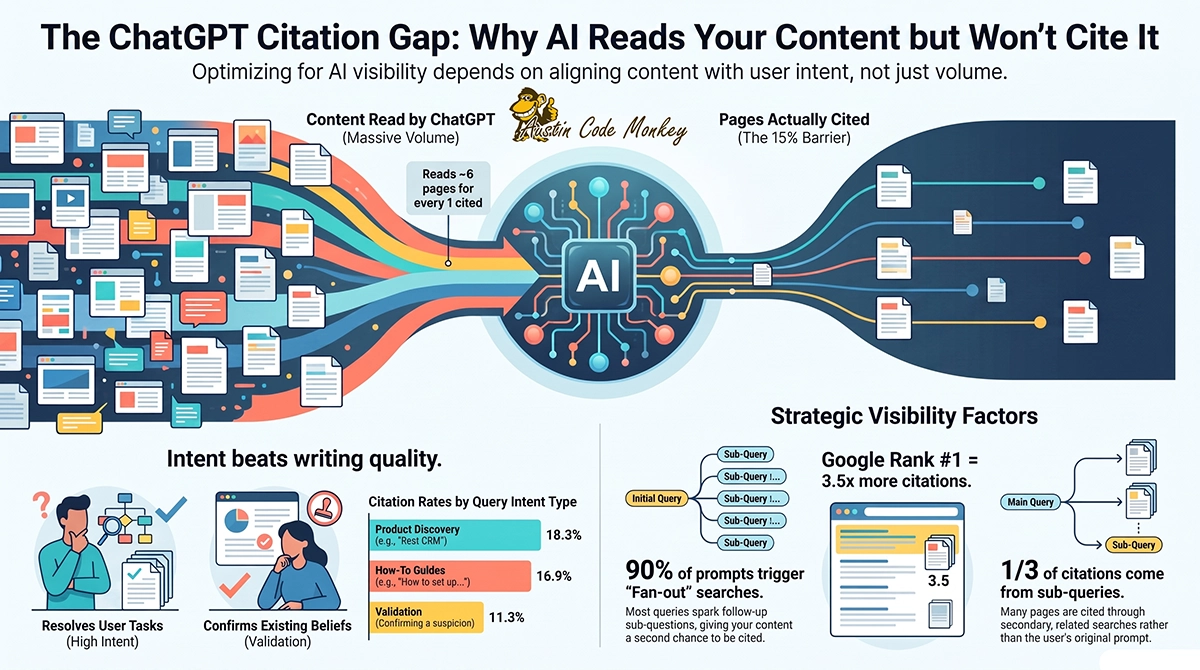
Here’s the part most AI-search advice skips: ChatGPT doesn’t rank your page the way Google does. It retrieves a pile of candidates, reads through them while building an answer, and then cites a small fraction. In the Search Engine Land dataset, that fraction was 15%, meaning roughly 466,000 of the 548,534 pages retrieved got read and thrown out.
That’s not a small inefficiency. It means five out of six pages good enough to get pulled into the research process still lose the citation. Getting retrieved is table stakes now, not the finish line.
Citation rate depends on what the page is trying to do, not how well it’s written
This is the number that actually changes what you should publish next. The same study broke citation rate down by query intent, and the spread is wide.
- Product discovery queries (“best CRM for a five-person team”): 18.3% citation rate
- How-to queries (“how to set up GBP for a multi-location business”): 16.9% citation rate
- Validation queries, where the reader is confirming something they already suspect: 11.3% citation rate
A page written to help someone decide beats a page written to reassure someone by almost a two-to-one margin. That gap has nothing to do with writing quality. A well-written validation article can still lose to a mediocre decision-oriented one, because ChatGPT is optimizing for what resolves the user’s actual next step, not which page reads best.
Fan-out searches are a second chance most sites never plan for
Almost 90% of ChatGPT prompts trigger two or more follow-up searches as the model expands the original question into related sub-queries. Nearly a third of all cited pages in the study got pulled in only through one of those fan-out searches, not the query the user actually typed.
Practically, that means the page you wrote to answer “how much does a website cost” might get cited when someone asks a related question you never targeted. You can’t fully predict which sub-question will fire. What you can do is make sure a page answers its stated question completely enough that it survives being retrieved for something adjacent to it.
What this means if you’re running (or thinking about) an AI content pipeline
If your content strategy is “publish more,” this data is the reason to stop and re-sort what you already have before adding to the stack. A pipeline that produces twenty pages a month at an 11% citation rate is generating far less AI visibility than ten pages a month built around decisions, comparisons, and specific next steps.
Before you scale a programmatic content system, sort your existing pages by intent type: decision pages, how-to pages, and validation or brand-affirmation pages. If most of your output falls into that last bucket, that’s the fix, not more volume. This is also where AI content pipelines go wrong in practice. Automated generation is good at hitting a word count and a keyword. It’s not good, on its own, at noticing that half your new pages are duplicating intent, or that a batch of city pages all quietly became the same validation-style article with a different place name swapped in. That kind of drift needs a person watching for it. Programmatic content only works if someone’s actively managing cannibalization and quality drift as the pipeline runs, and that’s most of what separates a working AI content system from one that just produces noise nobody cites.
FAQ
Does ChatGPT rank pages the way Google does? No. Google returns a ranked list. ChatGPT retrieves candidate pages while researching an answer, then cites a small subset of what it read, typically around 15% based on the most recent large-scale analysis.
Why does citation rate vary by query type? ChatGPT appears to favor pages that help a reader decide or complete a task over pages that just confirm something the reader already believes. Product-discovery and how-to content get cited at meaningfully higher rates than validation-style content.
Does ranking well on Google still matter for ChatGPT citations? Yes. Over half of cited pages in the study also ranked in Google’s top 20 for a related query, and pages holding Google’s number one spot were cited about 3.5 times more often than pages outside the top 20. Traditional SEO and AI-search visibility are reading the same underlying signal.
Should a small business publish more content to get cited more often? Not automatically. Volume without intent-matching adds pages to the 85% that get retrieved and dropped. Sorting existing content by intent and fixing the weakest category usually beats adding more pages on top of an unsorted pile.
How fast can a business see a difference after restructuring content around this? There’s no fixed timeline since it depends on crawl frequency and how much existing content needs rework, but structural changes to how a page answers a question typically show up in citation behavior faster than waiting on new pages to get indexed and trusted.
Still have questions?
The rules of local search are being rewritten in real time, and most businesses don’t find out until a competitor shows up in Gemini’s answer instead of them. Austin Code Monkey specializes in feeding the AI what it needs: business data that’s structured, verified, and descriptive enough for Gemini, ChatGPT, and Google’s AI Overviews to choose you over the competition.
Contact us today to run an AI Visibility Audit and see exactly how your business appears (or doesn’t) across ChatGPT and the other AI search tools your customers are already using.
Austin Code Monkey
Phone: (737) 932-7532
Hours: Monday – Friday, 10:00 AM – 10:00 PM
Website: https://austincodemonkey.com/
Get Started Today:
- Schedule your complimentary SEO audit
- Discover how SEO and AI Search Optimization can transform your business
Don’t let your competitors dominate your business in search queries. Partner with Austin’s leading SEO company and ensure your business appears when and where your customers are searching. Contact Austin Code Monkey today and take the first step toward complete digital dominance in the Austin market.