You invest in SEO, check your rankings daily, and wonder why your competitor who started months after you is already showing up on page one. The timeline from optimization to results feels frustratingly opaque, especially when agencies promise different timeframes and you’re not sure who to believe.
SEO typically takes three to six months to show initial results, with substantial growth appearing between six and twelve months—but that’s just the starting point. This guide breaks down the month-by-month progression, the factors that speed up or slow down your timeline, and the early indicators that show you’re on the right track before rankings improve.
How long does SEO take to work
SEO typically takes three to six months to show initial results, with significant growth appearing between six and twelve months. New websites and those targeting highly competitive keywords often require longer timelines—sometimes up to a year or more—while established sites with strong domain authority can see improvements faster. The timeline depends on several interconnected factors: your website’s age and history, the competitiveness of your industry, the quality of your content, and the consistency of your optimization efforts.
Here’s what “results” actually means at different stages. You might notice increased impressions in Google Search Console within weeks, but actual traffic growth and conversions typically take longer to materialize. Think of it like planting a garden—you’ll see sprouts before you harvest vegetables.
Why SEO takes time in 2026
Search engines like Google crawl billions of web pages and evaluate countless signals before deciding which pages deserve top rankings. When you make changes to your site—whether improving content, fixing technical issues, or building backlinks—Google doesn’t immediately recognize and reward those improvements.
The crawling and indexing process alone can take days or weeks, depending on your site’s size and crawl budget (the number of pages Google will crawl on your site in a given timeframe). After Google indexes your changes, its algorithms assess how users interact with your content compared to competitors. Are people clicking your result? Do they stay on your page or bounce back to search results?
Google also prioritizes established, trustworthy websites over newer ones. This isn’t arbitrary—it’s a quality control mechanism designed to prevent spam and manipulation. Building the authority and trust signals that Google values requires consistent effort over months, not days.
Your competitors aren’t standing still either. While you’re optimizing, they’re likely doing the same. The competitive landscape constantly shifts, which means ranking improvements happen gradually as you prove your content provides more value than alternatives.
What makes SEO work? This episode unpacks the key factors—top-tier content, rock-solid technical health, and strong domain authority—that determine your timeline from initial results in 3-6 months to big wins in a year. See how Austin Code Monkey adds AI Search Optimization for ultimate local visibility.
Key factors that influence SEO speed
Several variables determine how quickly you’ll see SEO results. Understanding these factors helps set realistic expectations and identify where to focus your efforts.
Website age and history
Brand new websites face what many SEO professionals call a “sandbox period”—a phase where Google evaluates whether the site is legitimate and valuable before granting significant visibility. This period typically lasts three to six months for new domains. Established websites with clean histories and existing domain authority rank faster because they’ve already built trust with Google.
However, if your site has a history of penalties or low-quality content, you’ll need extra time to rebuild that trust. Think of it like credit repair—past mistakes take time to overcome.
Competition level and niche difficulty
Ranking for “best pizza in Austin” involves competing against dozens of established local restaurants with years of reviews and backlinks. Ranking for “artisan sourdough pizza delivery in East Austin” targets a more specific audience with less competition. Highly competitive industries like legal services, real estate, and healthcare typically require longer timelines and more aggressive strategies.
Local markets may have different competition levels than national ones. A local plumber in Austin might see results faster than a national e-commerce store selling the same products as Amazon.
Technical health and core web vitals
Google prioritizes websites that load quickly, work smoothly on mobile devices, and provide excellent user experiences. Core Web Vitals—metrics measuring loading speed, interactivity, and visual stability—directly impact how quickly your optimization efforts pay off.
Sites with significant technical issues like broken links, slow page speeds, or poor mobile responsiveness face delays because Google can’t properly crawl and evaluate the content. Fixing technical issues can lead to relatively quick improvements, sometimes within weeks.
Content quality depth and frequency
Comprehensive content that thoroughly answers user questions performs better than thin, superficial pages. Google’s algorithms have become sophisticated at identifying content that genuinely helps users versus content created solely to rank. Publishing frequency matters, but quality trumps quantity.
One well-researched, 2,000-word guide that becomes a go-to resource in your industry provides more value than ten shallow 300-word posts. Regular publishing schedules help, but strategic, high-quality content wins long-term.
Backlink profile strength
Links from other reputable websites act as votes of confidence in your content. Natural, relevant links from authoritative sources in your industry accelerate rankings significantly. Building these relationships takes time—you can’t simply buy your way to a strong backlink profile without risking penalties.
Earning links through exceptional content, industry partnerships, and genuine relationship-building provides lasting value but requires patience.
Local signals and citations
For local businesses, consistent NAP (Name, Address, Phone) information across the web impacts how quickly you appear in local search results. Google Business Profile optimization, local directory listings, and location-specific content all contribute to local visibility.
Local SEO often shows results faster than national campaigns because the competition pool is smaller and geographic signals provide clear ranking factors. You might see local pack appearances (the map results that show up for local searches) within two to three months if you optimize aggressively.
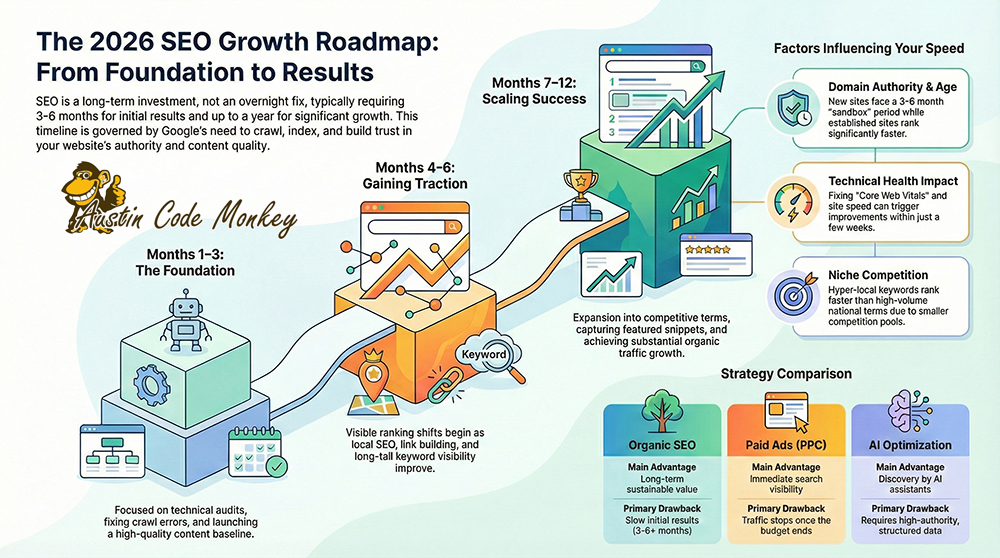
Month-by-month SEO timeline for the first year
Here’s what actually happens during each phase of an SEO campaign. Understanding this progression helps you recognize progress and stay committed when rankings haven’t materialized yet.
1. Month 1: Planning and audit
The first month focuses on foundation-setting: keyword research, competitor analysis, technical audits, and strategy development. You won’t see visible results yet, but this groundwork determines everything that follows. During this phase, you’ll identify which keywords to target, what content to create, and which technical issues need fixing.
2. Month 2: Technical fixes
Address crawl errors, improve site speed, fix broken links, and implement basic on-page optimization. Search engines begin noticing these improvements, though rankings typically haven’t changed yet. You might see increased crawl activity in Google Search Console and fewer errors in technical reports.
3. Month 3: Content foundation
Launch optimized content targeting your primary keywords. Begin seeing improved crawling and indexing activity as Google discovers your new pages. Some websites start appearing for long-tail keywords (longer, more specific search phrases) during this phase, though typically not on page one yet.
4. Month 4: Local SEO buildout
Optimize your Google Business Profile, build local citations, and create location-specific content. Local visibility may start improving, with some businesses appearing in map results for less competitive queries.
5. Month 5: Link outreach begins
Start earning quality backlinks through outreach, partnerships, and content promotion. Authority signals begin strengthening, though the full impact won’t be visible for another month or two.
6. Month 6: Data review and tweaks
Analyze early performance data, adjust strategy based on what’s working, and double down on successful tactics. Many businesses start seeing their first significant ranking improvements during this phase. You might notice certain pages climbing from page three to page two, or long-tail keywords reaching page one.
7. Month 7: Content expansion
Scale content production focusing on long-tail keywords and topic clusters (groups of related content pieces that comprehensively cover a subject). Broader keyword coverage develops as Google recognizes your site as a comprehensive resource in your industry.
8. Month 8: UX and conversion wins
Optimize for user experience improvements and conversion rate optimization. Engagement signals improve as visitors spend more time on your site and interact with your content.
9. Month 9: Authority building
Continue link-building efforts and establish thought leadership through high-quality content and industry connections. Your domain authority grows, making it easier to rank for increasingly competitive terms.
10. Month 10: SERP feature optimization
Target featured snippets (the answer boxes that appear at the top of search results), local pack results, and other search features for increased visibility. Structured data implementation and content formatting help you capture these prominent positions.
11. Month 11: Seasonal campaign alignment
Prepare for seasonal trends and events relevant to your business. Timing content for peak search periods ensures you’re visible when demand is highest.
12. Month 12: Scale and automate
Systematize successful processes and scale efforts. Significant ranking improvements are typically visible by this point, with many businesses seeing substantial increases in organic traffic compared to month one.
Early metrics to track before rankings improve
Waiting months for ranking improvements can feel frustrating, but several indicators show progress long before you hit page one.
- Crawl errors resolved: Monitor Google Search Console for decreasing crawl errors and increasing successfully indexed pages. A healthy, growing index indicates Google is discovering and evaluating your content.
- Impression and click-through lift: Watch for increasing impressions in search results, indicating improved relevance for target keywords. Even if you’re ranking on page two or three, growing impressions mean Google is testing your content with searchers.
- Local pack visibility: For local businesses, monitor appearances in map results and local search features. Local pack rankings often improve before organic rankings, providing early wins.
Five myths about fast SEO results
Misconceptions about SEO timelines lead to unrealistic expectations and poor decision-making. Here’s what to stop believing.
1. You can rank page one in 30 days
Any agency promising page one rankings within 30 days is either targeting extremely low-competition keywords or using manipulative tactics that risk penalties. Legitimate SEO for competitive terms requires months of consistent effort. While you might occasionally rank quickly for very specific long-tail keywords, sustainable rankings for valuable search terms don’t happen overnight.
2. More content always equals faster rankings
Publishing 50 mediocre blog posts won’t outperform ten comprehensive, well-researched guides. Quality and relevance matter more than volume. Strategic content planning that addresses user needs beats a quantity-focused approach every time.
3. Link quantity beats link quality
One high-quality, relevant link from an authoritative industry publication provides more value than 100 low-quality directory links. Focus on earning rather than buying links. Google’s algorithms can distinguish between natural links earned through valuable content and manipulative link schemes.
4. Once you rank you stay there
Rankings require ongoing maintenance and optimization. Competitors constantly improve their content, algorithm updates shift results, and user behavior evolves. SEO is not a “set it and forget it” strategy.
5. AI can replace all SEO work
While AI tools help with efficiency—generating content outlines, analyzing data, or identifying opportunities they can’t replace human strategy, creativity, and relationship-building. AI-generated content without human oversight often lacks the depth, nuance, and expertise that Google rewards.
Safe ways to accelerate SEO gains
You can speed up results without risking penalties by focusing on legitimate tactics that align with Google’s guidelines.
Target low-competition long-tail keywords
Focus on specific, less competitive phrases that are easier to rank for and often convert better. “Austin custom wedding cakes delivery” faces less competition than “wedding cakes” and attracts more qualified leads. Long-tail keywords also help you understand what your audience actually wants.
Optimize for featured snippets
Structure content to answer common questions directly, increasing chances of appearing in position zero. Use clear headings, concise definitions, and bullet points that Google can easily extract. Featured snippets provide visibility even when you rank below position one.
Earn local backlinks through partnerships
Build relationships with local businesses, organizations, and media for natural link opportunities. Sponsor local events, participate in community initiatives, or offer expert commentary to local publications. Local links are often easier to earn than national ones and provide strong relevance signals for local search.
Refresh high-potential legacy content
Update and improve existing content that’s close to ranking well rather than always creating new content. If you’re ranking on page two for a valuable keyword, refreshing that content with updated information, better formatting, and additional depth can push you to page one. This approach often delivers faster results than creating entirely new content because you’re building on existing authority.
SEO vs paid ads: When to mix channels
Comparing timelines helps you understand when combining organic and paid strategies makes sense for faster visibility.
Pros and cons of each
SEO advantages: Long-term value, credibility, cost-effective over time, sustainable traffic
SEO disadvantages: Slow results, requires expertise, ongoing effort needed, no guaranteed outcomes
Paid ads advantages: Immediate visibility, precise targeting, quick testing, predictable costs
Paid ads disadvantages: Expensive long-term, stops when budget ends, ad blindness, lower trust
Use paid to test keyword potential
Test keyword performance with ads before investing significant SEO effort. If a keyword doesn’t convert well through paid ads, it probably won’t perform better organically. This testing approach validates search volume and conversion potential before committing months to ranking organically.
Ready to accelerate your SEO timeline? Schedule a free consultation to learn how Austin Code Monkey can help your business achieve sustainable organic growth.
Ready to see sustainable results with Austin Code Monkey
SEO takes time, but you don’t have to navigate the complexity alone. Austin Code Monkey specializes in helping local Austin businesses build sustainable organic visibility through proven strategies tailored to your industry and competition level. Our team handles everything from technical optimization and content creation to link building and ongoing performance tracking.
Call for a free SEO consultation to discuss your business and learn how we can help you achieve measurable results.
Frequently Asked Questions About SEO Timelines
How long does it take for Yoast SEO to work?
Yoast SEO is a plugin that helps optimize content but doesn’t directly impact ranking speed—the timeline depends on your overall SEO strategy and implementation. The plugin provides recommendations and technical improvements, but you still need quality content, backlinks, and time for Google to recognize your efforts.
Does changing my domain name restart SEO progress?
Domain changes can reset much of your SEO progress, requiring months to rebuild authority and rankings under the new domain. If you change domains, proper 301 redirects (permanent redirects that pass link equity) and Google Search Console verification can minimize the impact, but expect three to six months of recovery time.
Will Google AI overviews make SEO take longer?
AI overviews are changing how results appear but don’t fundamentally alter SEO timelines quality content and technical optimization remain important. Focus on creating comprehensive, authoritative content that answers user questions thoroughly, and you’ll remain competitive regardless of how Google displays results.
Ready to dominate both traditional search results and AI-powered platforms? Austin Code Monkey’s expert team is ready to transform your online visibility and help you capture more customers across every channel where they search.
Austin Code Monkey
Phone: (737) 932-7532
Hours: Monday – Friday, 10:00 AM – 10:00 PM
Website: https://austincodemonkey.com/
Get Started Today:
- Call (737) 932-7532 for a free consultation
- Schedule your complimentary SEO audit
- Discover how SEO and AI Search Optimization can transform your business
Don’t let your competitors dominate your business in search queries. Partner with Austin’s leading local SEO experts and ensure your business appears when and where your customers are searching. Contact Austin Code Monkey today and take the first step toward complete digital dominance in the Austin market.