

When someone searches for your business right now, will they find you—or your competitor down the street? For most local businesses, that single moment when a potential customer searches “near me” determines whether they’ll earn that sale or watch it go elsewhere.

Local SEO positions your business to appear exactly when nearby customers are actively looking for what you offer, turning those critical search moments into phone calls, foot traffic, and revenue. This guide walks through what local SEO actually does to attract customers, which ranking factors matter most, and the specific steps you can take today to start showing up in local searches.
What is local SEO?
Local SEO is the practice of optimizing your online presence to appear in search results when people look for businesses in a specific geographic area. When someone searches “coffee shop near me” or “plumber in Austin,” local SEO determines which businesses show up in those results.
The key difference from regular SEO is geographic targeting. While traditional SEO helps a national e-commerce site rank for “running shoes,” local SEO helps your Austin store appear when someone searches “running shoes Austin” or “shoe store near me.” This geographic focus relies on three main elements: your Google Business Profile, location-based keywords in your website content, and citations (mentions of your business name, address, and phone number across the web).
Local SEO isn’t just about today; you need to prepare for tomorrow. This episode covers emerging AI search optimization and voice search tactics to keep your business visible in "map pack" results and beyond. Learn to stay ahead of competitors with forward-thinking strategies.
Why local SEO is important to your business
Local SEO places your business in front of people actively searching for your services right now. Someone searching for a business “near me” typically plans to make a purchase or book a service within hours—not weeks or months from now.
Here’s what makes local SEO particularly valuable:
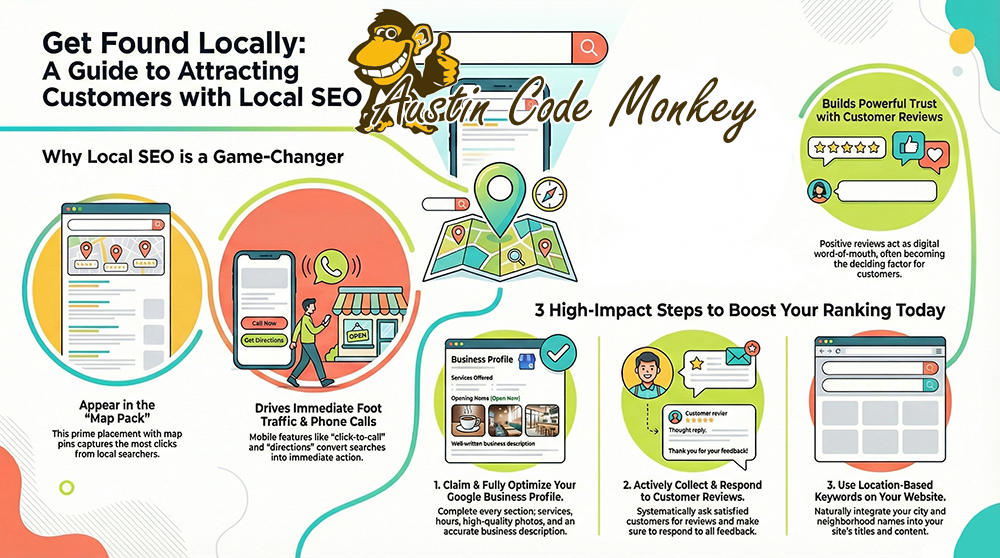
- Higher visibility in local searches: Your business appears in the map pack (three businesses shown with map pins at the top of results) and local organic listings when customers search for services in your area
- Built-in credibility: Customer reviews, consistent business information, and local presence create immediate trust with people evaluating their options
- Competitive edge: Many local businesses haven’t optimized for local search yet, which means you can outrank competitors who rely only on word-of-mouth or traditional advertising
- Long-term value: Organic local search results keep delivering customers long after you’ve invested in optimization, unlike paid ads that stop the moment your budget runs out
For Austin businesses, local SEO levels the playing field. A well-optimized small restaurant or service provider can compete with larger companies that have bigger advertising budgets.
How local SEO attracts more customers
Local SEO intercepts potential customers at the exact moment they’re looking for what you offer. The customer journey typically starts with a problem or need, moves through a local search, and ends with a visit or purchase—and local SEO puts you in front of them during that critical decision-making moment.
Higher online visibility
The map pack—those three businesses displayed with a map at the top of local searches—captures most clicks from local searchers. Appearing there dramatically increases your chances of attracting new customers. Your optimized Google Business Profile can show up in both search results and Google Maps, which many people use specifically to find nearby businesses.
Mobile searches amplify this effect. Most “near me” searches happen on smartphones from people already out looking for a business to visit right now.
Local trust signals and reviews
Customer reviews function as digital word-of-mouth recommendations. When potential customers see your business has dozens of positive reviews with specific details about experiences, they feel more confident choosing you over competitors with fewer or lower-quality reviews.
Your Google Business Profile displays your average rating, total review count, and recent reviews directly in search results—before someone even clicks to your website. This immediate social proof often becomes the deciding factor when people compare similar businesses.
Increased foot and phone traffic
Local SEO drives both digital and physical interactions through features like click-to-call buttons and driving directions. When your business appears in mobile search results, customers can tap your phone number to call immediately or tap “directions” to navigate directly to your location.
A searcher might find your business, call to ask a quick question, and book an appointment or visit your store within the same hour. For service businesses and retail stores, this immediate action drives revenue.
Better conversion rates on site and in store
Local search traffic converts at higher rates than general website traffic because visitors have clear intent and immediate need. Someone searching “emergency plumber Austin” is ready to hire someone right now, not researching options for future consideration.
Proximity also increases conversion. People searching for local businesses typically prefer nearby options for convenience, faster service, and the ability to visit in person if needed.
Key ranking factors that influence the map pack
The map pack appears above regular search results and captures most clicks from local searchers. Google uses several signals to determine which three businesses earn these spots.
Google Business Profile signals
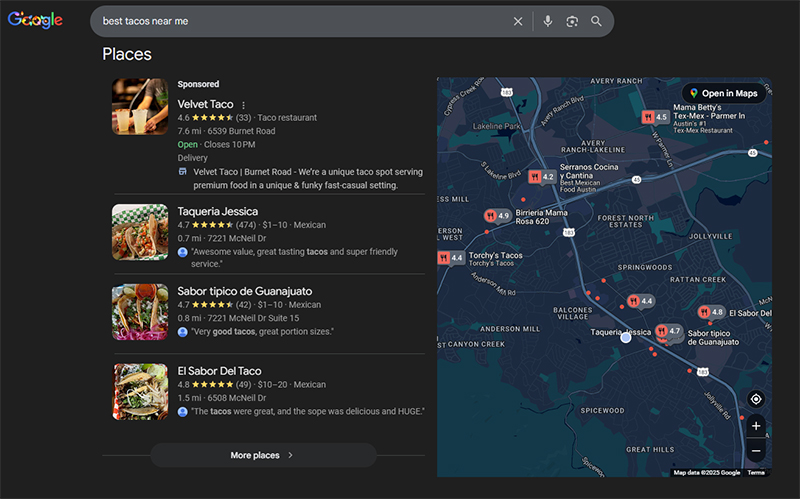
Your Google Business Profile completeness and accuracy directly impact your local rankings. Google favors businesses that provide comprehensive information, including detailed business descriptions, accurate categories, complete service lists, business hours, and high-quality photos.
Regular updates to your profile—like posting updates, adding new photos, or updating seasonal hours—signal to Google that your business is active and engaged. Choosing the most specific, relevant primary category for your business is particularly important because Google uses this to determine which searches your business is relevant for.
On-page local keywords
Incorporating location-based keywords naturally into your website content helps Google understand your geographic relevance. This means including your city name, neighborhood names, and local landmarks in your page titles, headers, service descriptions, and body content where it makes sense.
The key is natural integration. Forcing “Austin” into every sentence feels spammy and hurts readability. Instead, focus on creating genuinely useful location-specific content like “We serve the South Congress neighborhood” or “Our Austin location offers same-day service to downtown businesses.”
Citations and local backlinks
Citations are online mentions of your business name, address, and phone number on other websites like directories, local business associations, and review sites. Consistent information across citations helps Google verify your business legitimacy and location.
Local backlinks from Austin-based organizations, news outlets, community websites, and business associations carry extra weight because they demonstrate your genuine connection to the local community. A link from the Austin Chamber of Commerce or a local news article about your business provides strong local relevance signals.
Review quantity and velocity
Both the total number of reviews and how frequently you receive new ones impact your rankings. A business with 100 reviews from the past year signals more activity and customer satisfaction than a business with 100 reviews accumulated over five years.
Google also considers review quality, length, and recency. Detailed reviews that mention specific services or experiences provide more value than generic “great service” comments. Responding to reviews—both positive and negative—demonstrates engagement.
User engagement and proximity
Google tracks how users interact with your listing, including how often people click for directions, visit your website, or call your business. Higher engagement rates signal that your business is relevant and valuable for those searches.
Physical proximity to the searcher’s location also matters significantly. If someone searches “coffee shop” from downtown Austin, Google prioritizes businesses actually located downtown over those in the suburbs, even if the suburban location has better overall optimization.
Seven steps to boost local marketing SEO today
Improving your local SEO doesn’t require months of work. You can implement several high-impact changes immediately.
1. Claim and optimize Google Business Profile
Start by claiming your Google Business Profile if you haven’t already, then complete every section thoroughly. Write a compelling business description that naturally incorporates your services and location, add your complete service list, upload high-quality photos of your business, team, and work, and verify your hours are accurate.
The attributes section lets you highlight features like “wheelchair accessible,” “free Wi-Fi,” or “outdoor seating.” These details help customers find businesses that meet their specific needs.
2. Collect and respond to customer reviews
Develop a systematic approach to requesting reviews from satisfied customers, whether through follow-up emails, text messages, or in-person requests. Make it easy by providing direct links to your Google Business Profile review page.
Responding to every review—positive and negative—shows potential customers you value feedback and engage with your community. For negative reviews, respond professionally and offer to resolve issues offline.
3. Research and insert local keywords
Identify location-based keywords your customers actually use by thinking through their search journey. Someone looking for your services might search “your service + Austin,” “your service + neighborhood name,” or “your service near landmark.”
Incorporate keywords naturally into your website’s page titles, headers, service descriptions, and blog content. Create location-specific service pages if you serve multiple areas, making sure each page provides unique, valuable content rather than duplicating the same text with different city names.
4. Build location pages and service area content
If you serve multiple locations or neighborhoods, create dedicated pages for each area that provide genuinely useful, unique content. Pages might include area-specific service information, local team members, neighborhood-specific testimonials, or content addressing unique needs of that community.
Avoid creating thin, duplicate content across multiple location pages. Google recognizes and devalues this approach. Each location page offers distinct value to visitors from that area.
5. Earn local backlinks and citations
Reach out to local organizations, chambers of commerce, industry associations, and community groups about membership or partnership opportunities that include website listings. Sponsor local events, participate in community activities, or contribute expert insights to local news outlets to earn genuine local backlinks.
Submit your business to relevant local directories and industry-specific directories, making sure your name, address, and phone number are identical across all listings. Inconsistent information confuses Google and can hurt your rankings.
6. Ensure mobile speed and UX
Most local searches happen on mobile devices, so your website has to load quickly and function flawlessly on smartphones. Test your site’s mobile speed using Google’s PageSpeed Insights tool and address any issues that slow load times.
Make sure your phone number is clickable (allowing mobile users to call with one tap), your address links to mapping applications, and navigation is simple on small screens.
7. Monitor performance and iterate
Track your local search rankings for key terms, monitor your Google Business Profile insights to see how customers find and interact with your listing, and use Google Analytics to understand which local keywords drive website traffic.
Set aside time monthly to review performance, adjust your strategy based on results, and continue refining your approach. Local SEO is ongoing work, not a one-time project.
Tracking results and ROI of marketing local SEO
Measuring local SEO success requires tracking multiple metrics that connect online visibility to real business outcomes.
Call and click-to-call tracking
Implement call tracking numbers on your website and Google Business Profile to attribute phone calls to specific marketing sources. Many call tracking platforms integrate with Google Analytics, allowing you to see which keywords and pages drive calls.
Monitor click-to-call actions from your Google Business Profile through the insights dashboard, which shows how many people tapped your phone number directly from search results.
Map pack impressions and actions
Your Google Business Profile insights reveal how many people saw your listing in search results and maps, which searches triggered your appearance, and what actions people took. Actions include visiting your website, requesting directions, or calling your business.
Pay attention to trends over time rather than absolute numbers. Steady growth in impressions and actions indicates your optimization efforts are working. Sudden drops might signal ranking changes or increased competition requiring strategic adjustments.
Foot traffic and revenue attribution
While connecting online visibility to in-store visits remains challenging, you can track directional trends by asking new customers how they found you. Train your team to ask this question and record responses to understand which marketing channels drive foot traffic.
For businesses with point-of-sale systems, compare local SEO investment periods with revenue trends, accounting for seasonal variations.
Future trends shaping local customer acquisition
Local search continues evolving as new technologies change how customers discover and evaluate businesses.
Voice search and near me queries
Voice-activated searches through smartphones and smart speakers increasingly drive local discovery, with users asking conversational questions like “where’s the best taco place near me?” Voice queries differ from typed searches—they’re longer, more conversational, and often phrased as questions.
Optimizing for voice search means incorporating natural language and question-based keywords into your content, making sure your Google Business Profile is complete (voice assistants pull information from it), and creating content that directly answers common customer questions.
AI overviews and LLM seeding
AI-generated overviews now appear at the top of many search results, synthesizing information from multiple sources to answer user queries. LLM seeding—the practice of optimizing your content to be recognized and referenced by large language models—represents a new frontier in local SEO.
Austin Code Monkey specializes in this emerging area, helping businesses make sure their information appears in AI-generated responses when potential customers ask questions about local services.
Hyperlocal personalization
Search results continue becoming more personalized based on individual user behavior, search history, and precise location data. Two people searching the same term from locations just blocks apart might see different results based on their exact proximity and past interactions with local businesses.
This trend emphasizes the importance of consistent optimization across all local signals. Comprehensive local SEO helps you remain visible regardless of how personalization algorithms evolve.
Grow with Austin Code Monkey’s local SEO experts
If you’re ready to attract more local customers but don’t have time to manage the technical details, Austin Code Monkey offers comprehensive local SEO services tailored to Austin businesses. Our team combines deep knowledge of the Austin market with technical expertise in local optimization, content creation, and emerging strategies like LLM seeding for AI-driven search. Schedule a free consultation to discuss how local SEO can help your business stand out in Austin’s competitive market.
FAQs about local SEO customer attraction
How long does local SEO take to attract more customers?
Most businesses see initial improvements in local visibility within 8-12 weeks of implementing optimization changes. Significant customer attraction results typically occur after 4-6 months of consistent effort. The timeline varies based on your current optimization level, market competition, and how aggressively you implement changes.
What budget should a small business allocate for local SEO marketing?
Small businesses typically invest between $500-$2,000 monthly for professional local SEO services, though costs vary based on market competition and service scope. Local SEO functions as a long-term investment—the ongoing customer acquisition from organic rankings often exceeds the cost of paid advertising over time.
Can service-area businesses without physical locations benefit from local SEO?
Service-area businesses absolutely attract local customers through local SEO by optimizing for service areas rather than a physical address, creating location-specific content for each area served, and building local citations and backlinks. Google Business Profiles accommodate service-area businesses that don’t serve customers at their business address.
Do Google Ads improve organic local SEO customer attraction?
Google Ads and organic local SEO operate independently for customer attraction—paid ads don’t directly improve organic rankings. However, running both simultaneously can increase total visibility, and the immediate traffic from ads provides valuable data about which keywords and messaging resonate with local customers.
How does voice search change local SEO customer attraction strategies?
Voice search emphasizes conversational queries and question-based keywords, requiring businesses to optimize for natural language patterns like “where can I find” or “what’s the best” rather than short keyword phrases. Creating FAQ content that directly answers common customer questions helps capture voice search traffic.
Ready to Dominate Local SEO Rankings in Austin?
Call Austin Code Monkey Today!

Hours: Monday – Friday, 10:00 AM – 10:00 PM
Visit https://austincodemonkey.com/ to learn more about our comprehensive Local SEO services, and discover why Austin Code Monkey is your Austin SEO Company.
Your competitors are already investing in SEO. Don’t fall behind—partner with Austin Code Monkey and start capturing more customers searching for SEO for small business Austin services today. We’re ready to help your home services business thrive in the competitive Austin market through strategic search engine optimization and professional graphic design services.