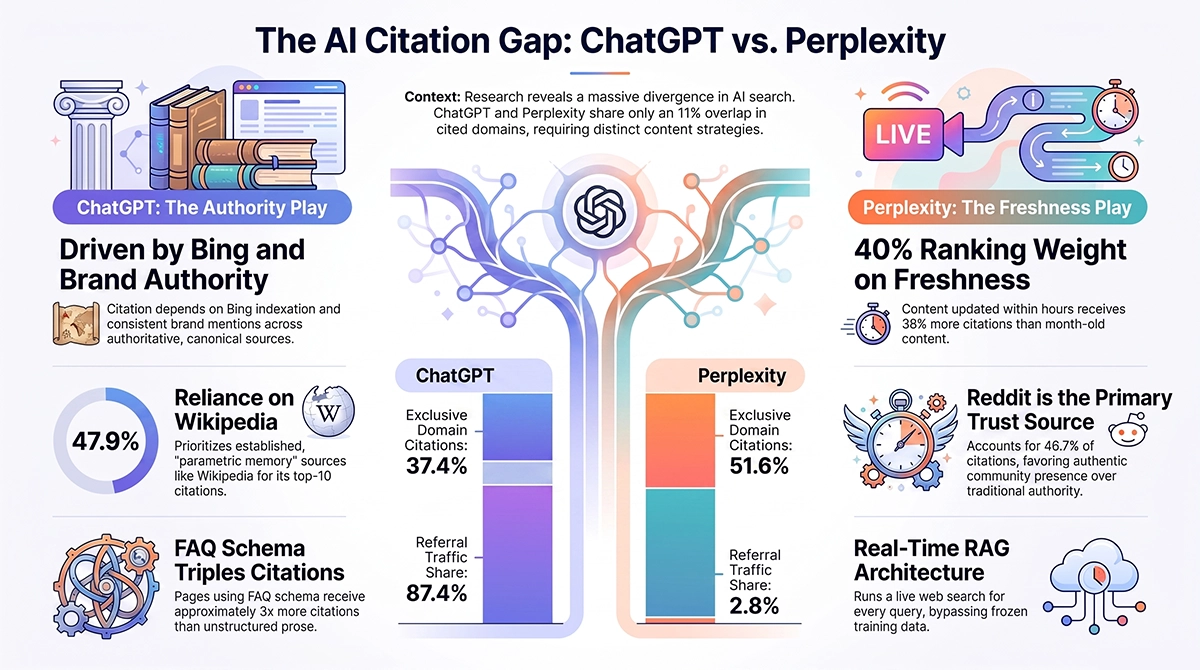
The short answer is yes, your content strategy needs to be different for each platform, and the gap between them is larger than most people expect. When the same 100,000 prompts were run through both engines, only 11% of cited domains appeared in both. 37.4% of domains were cited exclusively by ChatGPT, and 51.6% exclusively by Perplexity. That is not a rounding error. It means the content and authority signals that earn you a citation on one platform have almost no predictive value for the other.
The gap is not a measurement error. Each AI engine builds answers from a fundamentally different source pool, and the differences are getting wider, not narrower. For business owners and marketers who have been running a single content strategy and assuming it covers both, this data is a clear signal that they are flying blind on at least one of them.
ChatGPT and Perplexity share only 11% of the same sources when answering questions. This episode breaks down how ChatGPT favors established brand authority and Bing-aligned content, while Perplexity leans into real-time freshness and community platforms like Reddit. Discover why a one-size-fits-all content strategy no longer works.
Why the Two Engines Pick Such Different Sources
Unlike ChatGPT, which decides on a per-query basis whether to invoke web search, Perplexity runs real-time web retrieval for every single query without exception. There is no training-data-only mode for factual responses. That structural difference is the root cause of almost everything else.
A plain chatbot answers from a model’s frozen training data. Perplexity instead runs a retrieval-augmented generation (RAG) loop: for most queries it performs a live web search, pulls back current sources, and feeds those sources to a language model that writes the answer. The citations you see are the retrieved sources, not decorations added after the fact. Freshness is therefore baked into Perplexity’s ranking at a structural level. Freshness accounts for approximately 40% of the total ranking score. Half of all Perplexity citations come from content published in 2025. Content updated within hours of a query receives roughly 38% more citations than content that is a month old on the same topic.
ChatGPT works differently at almost every layer. ChatGPT Search relies on the Bing index and its own parametric memory. Your organic ranking on Bing directly determines your chances of being cited. That parametric memory, meaning what the model absorbed during training, is heavily shaped by canonical, authoritative sources. ChatGPT leans on Wikipedia for 47.9% of its top-10 citations, while Perplexity leans on Reddit for 46.7%. Those two numbers alone explain the citation gap. The engines are not using the same trust vocabulary.
Domains with strong off-site entity corroboration are 3.5 times more likely to be cited by ChatGPT than domains without it, according to Ahrefs data from 2025. That kind of corroboration, meaning consistent brand mentions across Wikipedia, Wikidata, press coverage, and industry publications, is precisely what Perplexity does not weight heavily. Perplexity wants fresh, structured, crawlable content it can extract from right now. ChatGPT wants proof that the broader web already considers you an authority.
What This Actually Means for Your Content and Off-Page Work
The practical split breaks down cleanly into two different playbooks, and trying to run just one will leave you invisible on at least one platform.
For ChatGPT visibility, the priority is authority and Bing indexation. ChatGPT Search is powered by Bing’s index for real-time web retrieval. One study found that ChatGPT search results share 73% overlap with Bing’s results. If your site is not indexed in Bing, it will not appear in ChatGPT responses, regardless of how well it ranks on Google. Most businesses have never touched Bing Webmaster Tools. That is a real gap now. Beyond indexation, published research, earned media, and industry analyst coverage contribute to the corroboration signals ChatGPT uses to assess brand authority. On-page, pages with FAQ schema receive approximately 3x more ChatGPT citations than equivalent unstructured prose, according to Authoritas research. Put your direct answer in the first paragraph of every major section. ChatGPT retrieves wide and cites narrow, so if your answer is buried, the page gets read and discarded.
For Perplexity visibility, the priority is freshness, structure, and genuine community presence. Pages with valid structured data appear 20 to 30% more often in AI-generated summaries than equivalent unstructured pages, according to 2025 benchmarks from Semrush and Measured.com. Update your top pages regularly. A page that has not been touched in six months is at a concrete disadvantage. Reddit is Perplexity’s single most-cited domain, accounting for 6.6% of all citations across all query types. Perplexity also offers a dedicated Reddit Focus Mode that restricts retrieval entirely to Reddit content. That means authentic, helpful participation in relevant subreddits is now a legitimate off-page tactic for Perplexity visibility, not a social media afterthought. Chasing Wikipedia citations will not move the needle here at all. Wikipedia is irrelevant to Perplexity, which cites it at effectively 0%, the opposite of ChatGPT’s 16.3% citation rate for Wikipedia.
The audience difference also matters for prioritization. Research from WARC in late 2025 found that 80% of Perplexity users are college graduates, 65% are high-income white-collar workers, and 30% hold senior leadership roles, with 41% working in tech, finance, or knowledge industries. Smaller volume, but a concentrated, high-intent audience worth reaching separately.
Where Austin Code Monkey’s Work Fits Into This
The 11% overlap figure is not an abstract data point for Austin Code Monkey. It is the core reason the agency runs platform-specific citation audits as a starting point for every AI Search Optimization engagement rather than a single unified content review. What gets cited on ChatGPT and what gets cited on Perplexity require different on-page signals, different off-page moves, and different measurement approaches. Running one audit and assuming it covers both is a reliable way to misdiagnose where a site’s visibility gap actually lives.
The practical workflow ACM uses starts with a prompt audit across both platforms for the client’s primary query categories, then maps the citation gap: which platform is missing the brand entirely, and which is citing it but for the wrong pages or topics. From there, the fix is usually not a content overhaul. It is targeted updates to high-potential pages for Perplexity freshness signals, Bing Webmaster Tools setup and indexation repair for ChatGPT, FAQ schema additions, and a structured plan for earned mentions in the sources each engine actually trusts. One cross-platform analysis documented citation volume variance of up to 615 times for the same brand between platforms. That kind of spread means a brand can look well-covered on one engine and be essentially invisible on another, and the only way to know which situation you are in is to test both directly. That is the work Austin Code Monkey is set up to do.
Frequently Asked Questions
Does ranking well on Google help me get cited by ChatGPT or Perplexity?
Not directly, and the relationship is weaker than most people assume. An Ahrefs study from August 2025 found that 80% of URLs cited by ChatGPT do not appear in Google’s top 100 for the same query. ChatGPT builds its own citation ecosystem based on content structure, authority signals, and semantic relevance. Bing indexation matters more than Google ranking for ChatGPT specifically. Perplexity runs its own live index and weights freshness above all else.
Does Perplexity actually run a live web search for every query, or does it use stored data like ChatGPT?
Unlike ChatGPT, which decides on a per-query basis whether to invoke web search, Perplexity runs real-time web retrieval for every query without exception. There is no training-data-only mode for factual responses. This is the foundational difference between the two platforms and why freshness is a dominant ranking signal on Perplexity but a secondary one on ChatGPT.
If I only have time to optimize for one platform, which one should it be?
ChatGPT generates roughly 87.4% of all AI referral traffic across industries, while Perplexity drives about 2.8%. On raw referral volume, ChatGPT is the higher-priority platform for most businesses. That said, Perplexity’s audience skews heavily toward high-income, senior-level professionals, so the right answer depends on your buyer profile, not just volume.
Want a Second Set of Eyes on Your AI Search Presence
If you want to know where your brand actually stands on ChatGPT and Perplexity right now, and where the gaps are, the most useful starting point is a prompt audit against your real query categories on both platforms. That is where the diagnosis lives. Austin Code Monkey runs exactly that kind of per-platform citation audit as a starting point for new clients. If it would help to have someone walk through it with you, call 737-932-7532 or visit austincodemonkey.com to start a conversation. No pitch, just a straight read on what the data shows.
Call 737-932-7532 or visit austincodemonkey.com to schedule your free audit. We’ll have you ranking higher and generating more leads within 30 days. El Jefe of SEO doesn’t make promises we can’t keep.
Contact us today to run an “AI Visibility Audit” and see how your business appears in the new Ask Maps world.
Austin Code Monkey
Phone: (737) 932-7532
Hours: Monday – Friday, 10:00 AM – 10:00 PM
Website: https://austincodemonkey.com/
Get Started Today:
- Schedule your complimentary SEO audit
- Discover how SEO and AI Search Optimization can transform your business
Don’t let your competitors dominate your business in search queries. Partner with Austin’s leading SEO company and ensure your business appears when and where your customers are searching. Contact Austin Code Monkey today and take the first step toward complete digital dominance in the Austin market.