

You’re staring at your website analytics, watching competitors outrank you on Google, wondering if throwing money at an SEO expert is the answer or just another business expense you can’t afford. The truth is, most Austin business owners face this exact dilemma, caught between the complexity of modern search optimization and the reality of limited budgets and time.

This guide breaks down when professional SEO help makes sense, what it actually costs, and how to evaluate whether you can realistically handle optimization yourself. You’ll learn the specific warning signs that indicate DIY isn’t working, what to look for when vetting agencies, and alternatives between doing everything yourself and hiring full-service help.
Why DIY SEO costs more in the long run. This episode highlights how hiring Austin Code Monkey for AI search optimization, technical SEO, and local map packs frees up your time while delivering proven ROI that outperforms competitors.
Should I Hire an SEO Company
Yes, hiring an SEO company is worth it if you want to compete effectively in search results, though the right choice depends on your specific situation. Most small businesses benefit from professional help because SEO requires specialized knowledge, consistent effort, and time that busy owners simply don’t have.
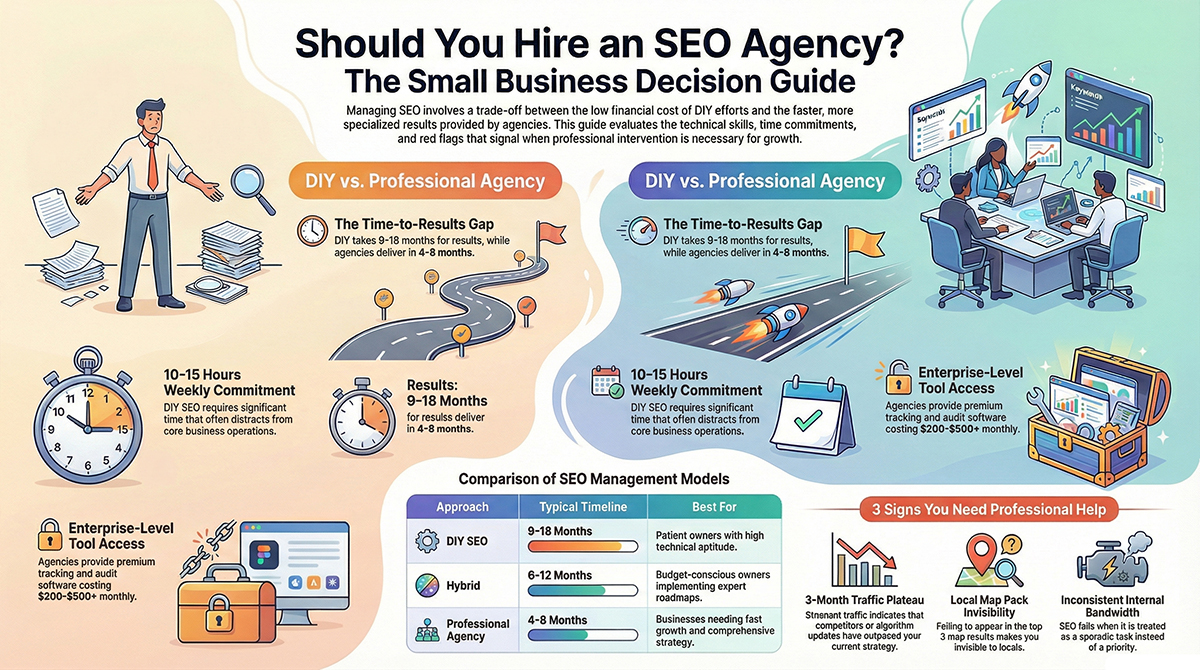
The real question isn’t whether SEO matters—it clearly does—but rather whether you can realistically handle it yourself. Think about it this way: if you’re running a restaurant, managing staff, ordering inventory, and serving customers, when exactly will you find 10-15 hours per week to learn technical optimization, write content, and build backlinks?
DIY Skill and Time Self-Assessment
Before deciding anything, take an honest look at your current knowledge and available hours. If you understand concepts like XML sitemaps, schema markup, and backlink analysis, and you can commit 10-15 hours weekly, DIY might work initially. However, most business owners find themselves stretched between operations, customer service, and marketing.
Here’s what to consider:
- Can you dedicate 10+ hours weekly to SEO without neglecting core business operations?
- Do you understand technical concepts like canonical tags, crawl budgets, and page speed optimization?
- Are you willing to continuously learn as Google updates its algorithm several times per year?
Competitive Landscape in Your Niche
Your industry’s competition level dramatically affects whether DIY efforts will succeed. In low-competition niches—think specialized B2B services or hyperlocal businesses with few competitors—basic optimization might help you rank well. High-competition industries like restaurants, real estate, or legal services in Austin require sophisticated approaches that professionals bring to the table.
Here’s the reality:
- Low competition: Basic on-page optimization and consistent Google Business Profile management might suffice
- Moderate competition: Strategic content creation, local citations, and technical SEO knowledge become necessary
- High competition: Professional expertise becomes essential to compete with established businesses investing heavily in SEO
Growth Goals and Deadlines
Your business objectives and timeline expectations directly influence whether professional help makes sense. If you’re aiming for steady, gradual growth over 12-18 months and have patience to learn, DIY could work. However, if you’re launching a new location or competing against well-established rivals, professionals accelerate the process significantly.
| Approach | Typical Timeline to Results | Best For |
|---|---|---|
| DIY SEO | 9-18 months | Patient owners with technical aptitude and available time |
| Professional Agency | 4-8 months | Businesses needing faster results and a comprehensive strategy |
| Hybrid (Audit + DIY) | 6-12 months | Budget-conscious owners willing to learn and implement |
Signs Your Business Needs Professional SEO Help
Certain warning signs indicate when DIY efforts aren’t working anymore. Recognizing early can prevent months of stagnation and missed opportunities.
Traffic Plateau or Decline
If your website traffic has flatlined for three or more months despite your efforts, something’s not working. This pattern often means either your competitors have outpaced you, Google’s algorithm updates have affected your rankings, or your current approach has fundamental flaws. For Austin businesses competing in crowded markets, stagnant traffic typically translates directly to lost revenue as potential customers find your competitors instead.
Low Local Map Pack Visibility
The local map pack—those three business listings that appear with map pins at the top of local search results—represents prime real estate for local businesses. If you’re not appearing in this section when people search for your services in Austin, you’re invisible to a significant portion of potential customers.
Local map pack optimization requires specific technical knowledge, including Google Business Profile optimization, local citations, review management, and location-based schema markup. Schema markup is structured data that helps search engines understand your business information, like hours, services, and location. Most business owners find this technical layer challenging to master.
Limited Internal Bandwidth
Running a business involves juggling countless responsibilities, from managing employees to handling finances to serving customers. When SEO consistently falls to the bottom of your priority list because you’re overwhelmed with daily operations, it’s time to consider professional help. Inconsistent SEO efforts—optimizing sporadically when you find time—rarely produce meaningful results because search engines reward consistent activity.
Benefits and Drawbacks of DIY SEO
Understanding both sides helps you make an informed decision about handling SEO internally.
Pros of Keeping SEO In-House
DIY SEO offers several advantages worth considering. You avoid monthly agency fees, though you’ll invest significant time instead. No one understands your unique value proposition, customers, and services better than you do. You make all decisions without waiting for agency communication or approvals. Plus, learning SEO benefits your business long-term, even if you eventually hire help.
Cons That Limit Long-Term Growth
The drawbacks of DIY SEO often outweigh the benefits for most business owners. Mastering SEO fundamentals takes months, and staying current requires ongoing education. Effective SEO demands 10-20 hours weekly, time that could go toward revenue-generating activities.
Professional-grade SEO tools cost $200-500+ monthly, expenses that might not make sense for DIY efforts. Without experience, you’ll make mistakes and miss opportunities that professionals spot immediately. Algorithm updates can tank your rankings overnight if you lack deep expertise.
Why Hire an SEO Company for Local Austin Growth
Professional SEO services deliver specific advantages that directly impact your bottom line, especially in competitive local markets like Austin.
Access to Specialized Local SEO Tools
SEO agencies use premium software platforms that cost thousands annually, investments that make sense for agencies serving multiple clients but not for individual businesses. Local citation management systems track your business listings across 50+ directories. Rank tracking software monitors your position for hundreds of keywords. Technical audit platforms identify issues invisible to the naked eye. You’re essentially accessing enterprise-level resources at a fraction of the cost.
Up-to-Date Algorithm Expertise
Google updates its search algorithm thousands of times yearly, with major updates several times per year that can dramatically shift rankings. An algorithm update is a change to how Google evaluates and ranks websites, potentially affecting which sites appear in search results. Professional SEO experts monitor changes, understand their implications, and adjust strategies accordingly—knowledge that takes years to develop and constant attention to maintain.
Integrated Content and Video Strategies
Effective local SEO extends beyond technical optimization to include content marketing, business explainer videos, and social media integration. Agencies combine elements into cohesive strategies that reinforce each other, for example, creating location-specific content that answers common customer questions while incorporating business explainer videos that improve engagement and conversion rates.
Cost Comparison of In-House, Freelancer, and Agency SEO
Understanding different pricing structures helps you evaluate what fits your budget.
Salary and Overhead for an In-House Hire
Hiring a full-time SEO specialist in Austin typically costs $50,000-$75,000 annually in salary alone. Benefits like health insurance, retirement contributions, and paid time off add roughly 30% of salary. Factor in recruitment costs, training, software subscriptions, and the reality that one person can’t cover all SEO specialties—technical, content, link building, local optimization. Your total investment easily exceeds $75,000-$100,000 yearly for someone who might lack experience in certain areas.
Project Fees for Freelance Specialists
Freelancers charge $75-$200 per hour or $2,000-$10,000 for specific projects like site audits, content creation, or technical fixes. This approach works well for one-time needs or supplementing your efforts. However, coordinating multiple freelancers for different specialties becomes complicated. You’re also dependent on individual availability and expertise—if they’re unavailable or lack skills in certain areas, you’re stuck.
Retainer Ranges for SEO Agencies
Agencies typically charge monthly retainers that include comprehensive services—strategy, technical optimization, content creation, link building, and reporting. This model provides predictable costs, consistent effort, and access to teams with diverse expertise. The ongoing relationship means your SEO compounds over time rather than starting and stopping with project-based work.
What To Look For When Hiring an SEO Company
Vetting potential partners carefully protects you from wasting money on ineffective services.
Proven Local Ranking Case Studies
Ask agencies to show specific examples of local businesses they’ve helped rank in Austin or similar markets. Look for case studies that include starting positions, timeframes, and measurable results like traffic increases or lead generation improvements. Generic testimonials without data don’t prove anything—you want evidence of actual ranking improvements for businesses similar to yours.
Transparent Reporting and KPIs
Reputable agencies provide clear monthly reports tracking key performance indicators (KPIs)—specific metrics that measure progress toward your goals. Essential KPIs for local businesses include organic traffic (visitors from search engines), local pack rankings (your position in map results for target keywords), keyword rankings (where you rank for important search terms), conversion rates (percentage of visitors who become leads or customers), and Google Business Profile insights (views, clicks, and calls from your profile).
If an agency can’t explain what they’ll track or provide vague “we’ll improve your rankings” promises without specifics, that’s a red flag.
Ethical White-Hat Practices
White-hat SEO refers to optimization techniques that follow search engine guidelines, while black-hat SEO uses manipulative tactics that violate those rules. Black-hat techniques like buying links, keyword stuffing, or creating fake reviews might produce quick results but risk severe penalties, including complete removal from search results. Ask potential agencies directly about their methods—ethical practitioners will explain their strategies transparently and emphasize sustainable, guideline-compliant approaches.
How To Vet an SEO Expert Step by Step
Follow this systematic process to evaluate potential SEO partners thoroughly.
1. Review Portfolio and References
Request detailed case studies showing their work with local Austin businesses or similar markets. Contact at least three references directly, asking specific questions about results achieved, communication quality, and whether they’d hire the agency again. Pay attention to how recently the case studies occurred—SEO changes rapidly, so success from five years ago matters less than recent achievements.
2. Ask Technical and Strategy Questions
Test their expertise with questions about local citation building, Google Business Profile optimization, technical issues like site speed and mobile optimization, content strategy for local businesses, and staying current with algorithm updates. Their answers are specific and detailed, not filled with jargon meant to impress. If they can’t explain concepts clearly, they either don’t understand them well or aren’t interested in educating you.
3. Clarify Contract Terms and Deliverables
Understand exactly what you’re paying for each month. Deliverables might include a certain number of optimized pages, blog posts, local citations, or technical fixes. Clarify contract length, cancellation terms, and what happens to your content and data if you end the relationship.
4. Align on Tracking and ROI Targets
Establish clear success metrics before signing anything. What specific improvements do you expect in three months, six months, and one year? How will the agency demonstrate return on investment? Discuss realistic timelines—anyone promising first-page rankings in 30 days is either lying or using risky tactics.
Alternatives to a Full-Time SEO Engagement
Several middle-ground options exist between pure DIY and full agency services.
One-Time Audits and Roadmaps
An SEO audit is a comprehensive analysis of your website, identifying technical issues, content gaps, and optimization opportunities. Many agencies offer standalone audits that include a detailed roadmap you can implement yourself or with minimal ongoing support. This approach works well if you have some technical capability but want expert guidance on priorities and strategy.
Training Your Internal Team
Some agencies offer SEO training programs where they teach your staff or marketing team how to handle optimization internally. You’re essentially paying for knowledge transfer rather than ongoing services. This hybrid approach makes sense if you have someone with marketing experience who can dedicate significant time to SEO after receiving proper training.
Hybrid Retainer Plus Consulting
A scaled-down retainer where an agency handles the most technical or time-consuming aspects, like technical optimization and link building, while you manage content creation and day-to-day tasks, offers a cost-effective compromise. You get expert guidance and support for the hardest parts while maintaining control and reducing costs.
Realistic Timeline and ROI Expectations for SEO
Understanding what to expect prevents disappointment and helps you evaluate whether your investment is working.
Short-Term Wins Versus Long-Term Gains
Some improvements happen relatively quickly, while others take months to materialize. Quick wins in 1-3 months include Google Business Profile optimization, fixing critical technical errors, and basic on-page optimization. Medium-term results in 3-6 months show new content starting to rank, local citations improving visibility, and technical improvements showing traffic increases. Long-term gains in 6-12+ months bring competitive keyword rankings, sustained traffic growth, and established authority in your niche.
SEO is fundamentally a long-term investment—anyone promising overnight results is setting unrealistic expectations or using risky tactics.
Metrics That Matter for Local Businesses
Focus on metrics that directly connect to revenue rather than vanity metrics that look impressive but don’t impact your bottom line. Local search visibility means appearing in map pack results for your core services. Qualified traffic refers to visitors from your service area searching for what you offer. Lead generation includes form submissions, phone calls, and direction requests from search. Conversion rate measures the percentage of visitors who become customers. Customer lifetime value tracks revenue generated from customers acquired through search.
Rankings matter, but only as a means to business outcomes.
Ready To Elevate Your Austin Business With Expert SEO
The decision to hire SEO help ultimately comes down to your resources, timeline, and growth ambitions. If you have the time, technical aptitude, and patience to learn, DIY SEO can work for less competitive niches. However, most Austin businesses competing in crowded markets benefit significantly from professional expertise that accelerates results and avoids costly mistakes.
Consider where you want your business to be in 12 months. If that vision includes significantly more customers from online search, stronger local visibility, and freedom to focus on what you do best, professional SEO support makes strategic sense.
Ready to discuss your specific situation? Schedule a free SEO consultation with Austin Code Monkey to explore what’s possible for your business.
FAQs About Hiring an SEO Expert
How does artificial intelligence impact SEO strategy for local businesses?
AI tools like ChatGPT and Google’s Search Generative Experience are changing how people search and find information. Professional SEO experts understand LLM seeding—the process of ensuring your business information appears accurately in AI-generated responses—which requires structured data, authoritative content, and strategic positioning. While AI tools can help with keyword research and content ideas, human expertise remains critical for strategic decisions, local market understanding, and adapting to rapidly evolving AI search features.
Can voice search optimization be effectively managed without professional help?
Voice search optimization requires technical implementation of schema markup, conversational content strategies, and featured snippet optimization. When someone asks Siri or Alexa for “best pizza near me,” the results depend on sophisticated technical factors like local business schema, review signals, and content structured to answer natural language queries. Professionals handle voice search elements more effectively than most business owners can manage alone.
What contract length works best when hiring an SEO company?
Most successful SEO partnerships operate on 6-12 month initial commitments, giving enough time for strategy implementation and measurable results while protecting you from being locked into underperforming relationships. Month-to-month contracts sound appealing, but they often mean the agency prioritizes short-term tactics over sustainable strategies. Look for agencies offering 6-month agreements with clear performance milestones and reasonable cancellation terms if they don’t meet expectations.
Who retains ownership of SEO content and data after ending a professional engagement?
You maintain full ownership of all website content, blog posts, videos, analytics access, and SEO assets created during the partnership—this is standard practice with reputable agencies. Before signing any contract, clarify that content created for your site belongs to you, you’ll retain admin access to all platforms like Google Analytics and Search Console, and you’ll receive all documentation if the relationship ends.
Contact Austin Code Monkey Today
Ready to dominate both traditional search results and AI-powered platforms? Austin Code Monkey’s expert team is ready to transform your online visibility and help you capture more customers across every channel where they search.

Austin Code Monkey
Phone: (737) 932-7532
Hours: Monday – Friday, 10:00 AM – 10:00 PM
Website: https://austincodemonkey.com/
Get Started Today:
- Call (737) 932-7532 for a free consultation
- Schedule your complimentary SEO audit
- Discover how SEO and AI Search Optimization can transform your business
Don’t let your competitors dominate your business in search queries. Partner with Austin’s leading SEO company and ensure your business appears when and where your customers are searching. Contact Austin Code Monkey today and take the first step toward complete digital dominance in the Austin market.